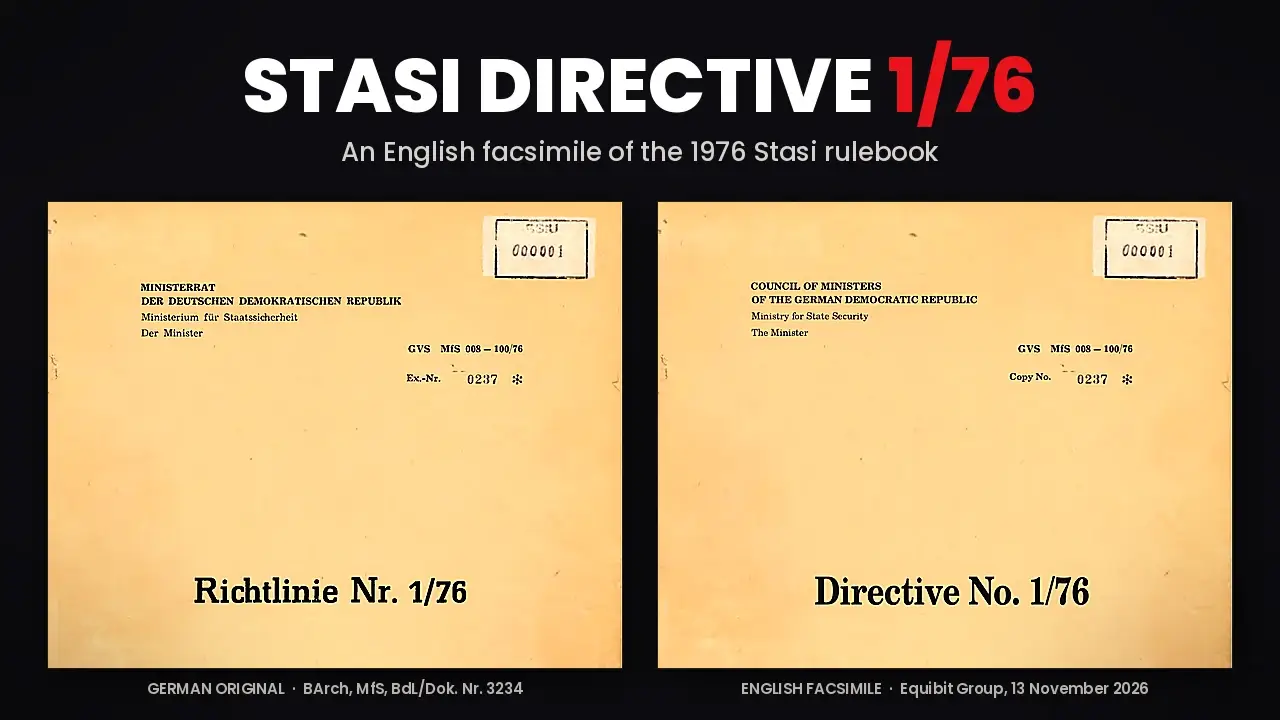

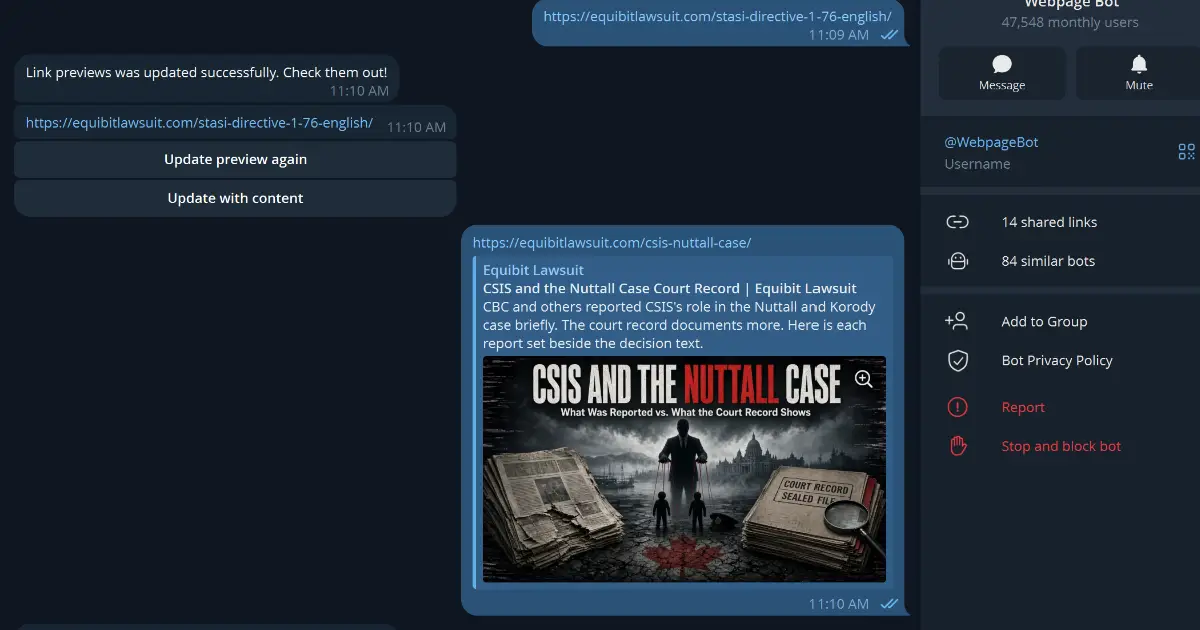
On the morning of 16 November 2026, Telegram’s link-preview crawler fetched a post on this site, drew a full preview card, and twelve minutes later fetched the same post again. In that same window it never requested a different post: the English translation of Stasi Directive 1/76. Horlacher asked Telegram’s @WebpageBot to refresh the Directive link. The bot replied that the preview had been updated. No card appeared. Our own control tests, presenting the same user-agent Telegram’s crawler uses, were served the Directive page and its featured image in full, HTTP 200, with a complete set of Open Graph tags.
This post records what the server logs show. It does not claim to know why Telegram’s crawler will not fetch that URL.
The 16 November test
Link previews are assembled by a crawler, not by the person who pastes the URL. The crawler that builds Telegram’s previews identifies itself as TelegramBot (like TwitterBot) and, on the dates in this post, arrived from addresses in Telegram’s published range 149.154.160.0/20, listed at core.telegram.org/resources/cidr.txt. A request that presents that user-agent is not, by itself, proof that it came from Telegram. The source addresses are what identify the fetcher.
CSIS and the Nuttall Case had been published that morning. The Stasi Directive 1/76 translation had been published on 14 November.
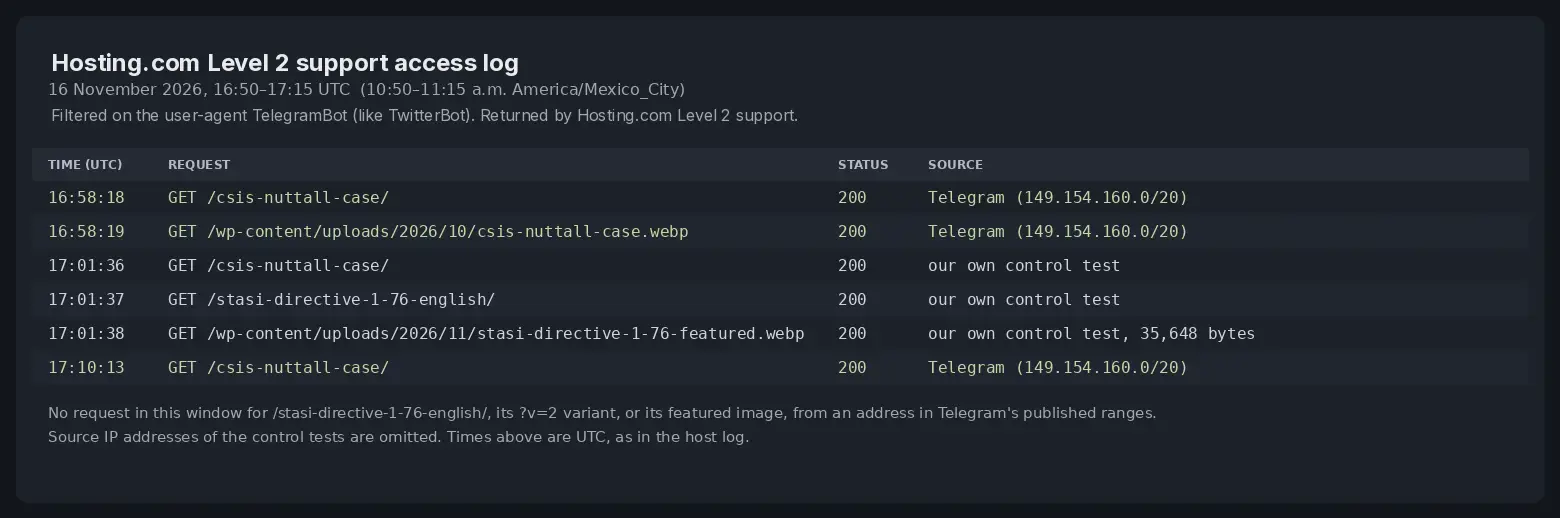
Hosting.com Level 2 support returned the TelegramBot lines for a window from about 10:50 a.m. to 11:15 a.m. America/Mexico_City on 16 November 2026 (16:50–17:15 UTC), filtered on that user-agent. Every request in that extract returned HTTP 200. The lines, with times in America/Mexico_City and the log’s UTC in brackets, are as follows. Source IP addresses of our own control tests are omitted.
- 10:58:18–19 a.m. (16:58:18–19 UTC). Telegram, from an address in
149.154.160.0/20, requested/csis-nuttall-case/and, one second later, its Open Graph image,/wp-content/uploads/2026/10/csis-nuttall-case.webp. - 11:01:36–38 a.m. (17:01:36–38 UTC). Our own control tests, presenting the TelegramBot user-agent, requested the Nuttall post, the Directive post, and the Directive featured image,
/wp-content/uploads/2026/11/stasi-directive-1-76-featured.webp. The image was 35,648 bytes. - 11:10:13 a.m. (17:10:13 UTC). Telegram, again from an address in
149.154.160.0/20, requested/csis-nuttall-case/. No image request was logged with that second fetch.
Telegram never requested /stasi-directive-1-76-english/, a ?v=2 variant of that URL, or the Directive featured image, from any address in its published ranges, in that window.
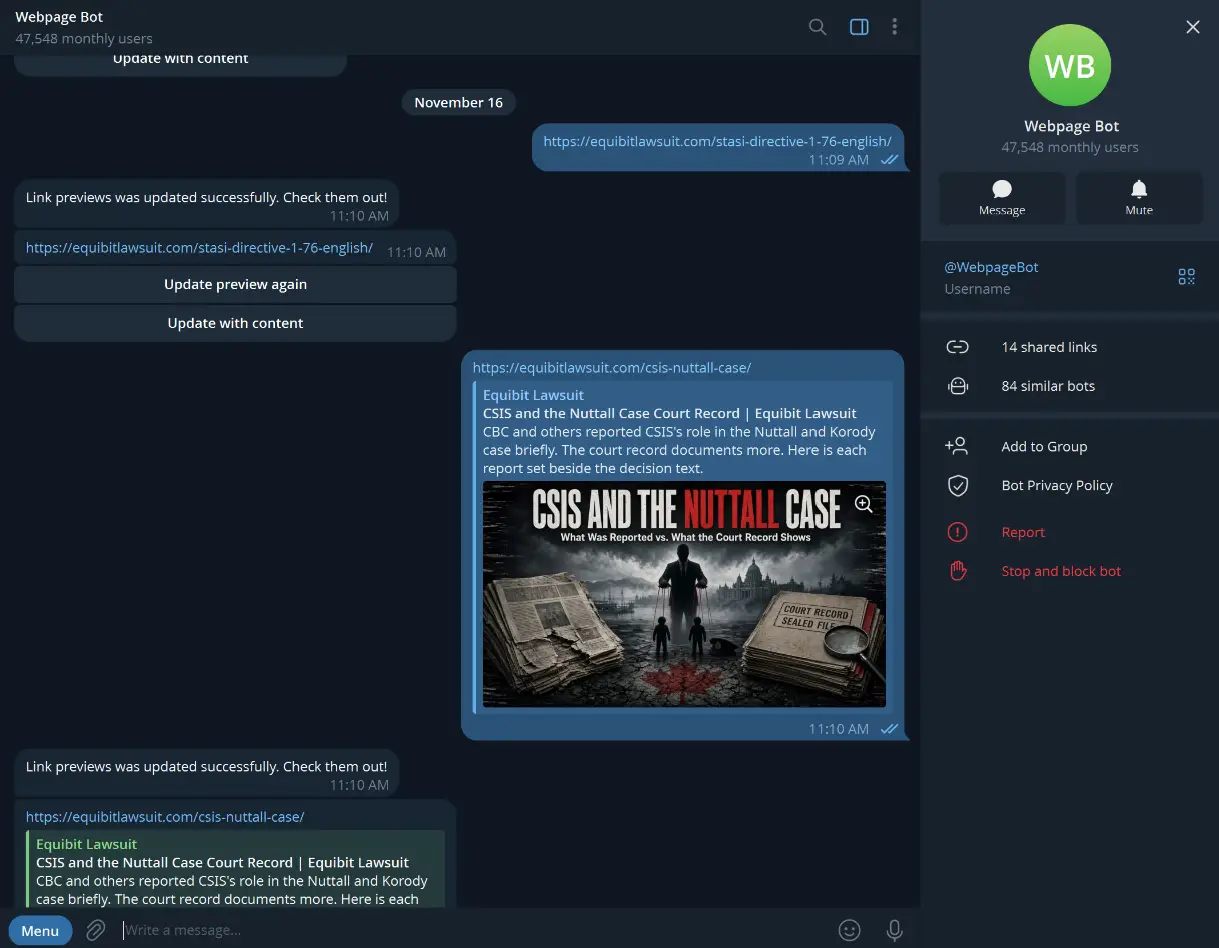
The user-facing test sits in the same minutes. At 11:09 a.m., Horlacher sent the Directive URL to Telegram’s @WebpageBot. At 11:10 a.m. the bot replied, “Link previews was updated successfully. Check them out!” No preview card appeared. In the same chat, at 11:10 a.m., he sent the Nuttall URL. A full card appeared — site name, title, description, and featured image — and the bot again said the preview had been updated. At 11:11 a.m. he sent the Directive URL with a cache-busting ?v=2 query string. The bot again said the preview had been updated. No card appeared.
What the earlier logs show
Hosting.com Level 2 support earlier produced the TelegramBot lines for 2–15 November 2026. Telegram’s fetcher, from addresses in 149.154.160.0/20, requested other posts on this site, each followed about a second later by its Open Graph image. Every request returned HTTP 200:
- 2 November, 11:20:22 a.m. America/Mexico_City (17:20:22 UTC): Marc Godard’s Failed Coups.
- 4 November, 2:00:42 p.m. (20:00:42 UTC): The Widow’s Son.
- 6 November, 10:32:00 a.m. (16:32:00 UTC): What Survived the Campaign Against Equibit.
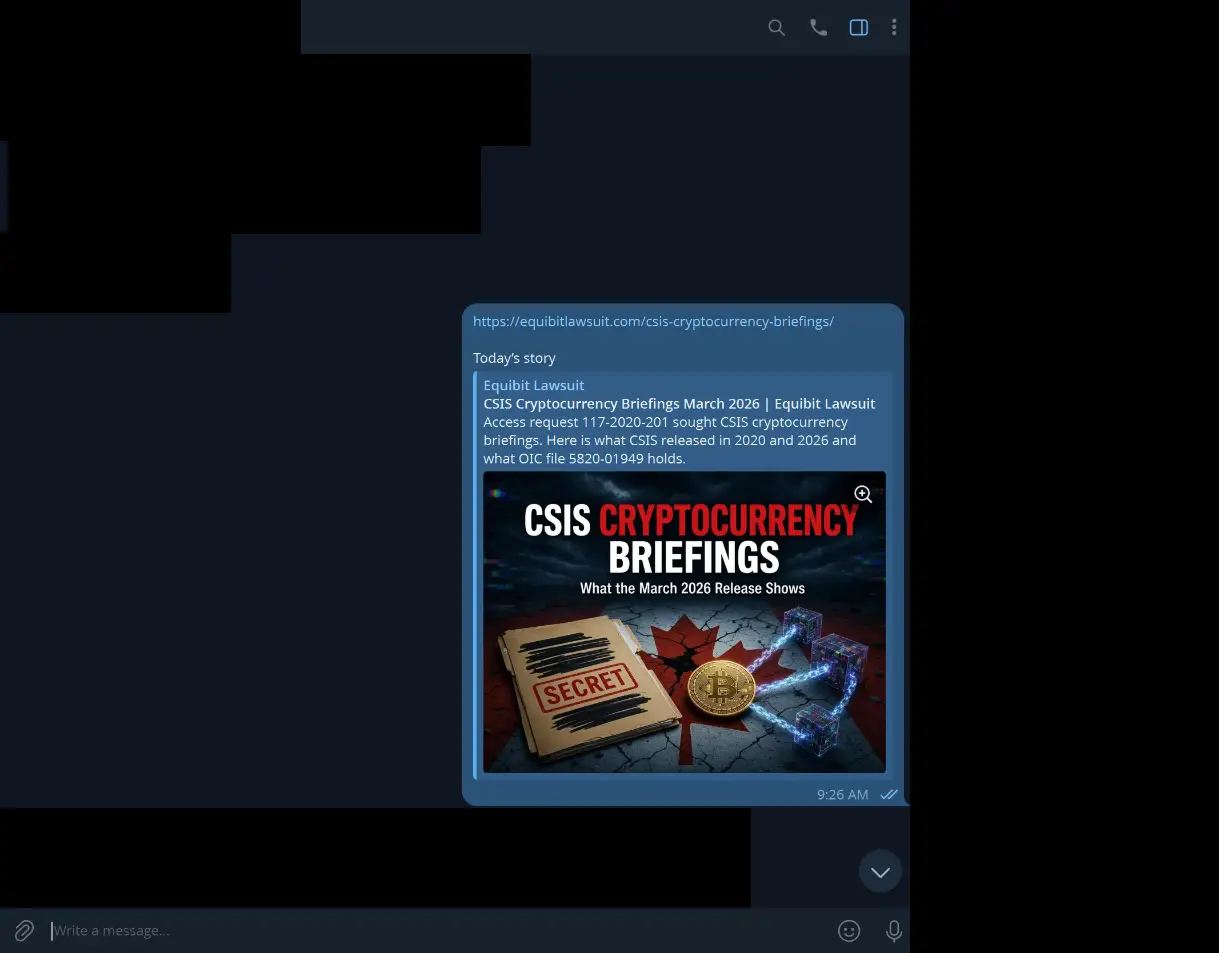
- 9 November, 9:26:28 a.m. (15:26:28 UTC): CSIS Cryptocurrency Briefings.
That 9 November fetch is in the same minute as a working preview card for the same post, in a private chat. The other party’s name, username, avatar and messages have been masked.
149.154.160.0/20.The Directive post was published at 8:00 a.m. America/Mexico_City on 14 November 2026. From that publication through the end of the 2–15 November log — 10:49:42 a.m. on 15 November (16:49:42 UTC) — and again through the 16 November test window, no address in Telegram’s published ranges requested /stasi-directive-1-76-english/.
The TelegramBot lines in that earlier log that did request the Directive page, and the lines that requested other URLs on 14 and 15 November, did not come from Telegram’s published ranges. They were our own control tests, or Hosting.com staff reproducing a fetch with the same user-agent. Those requests also returned HTTP 200, including the Directive page and its 35,648-byte featured image.
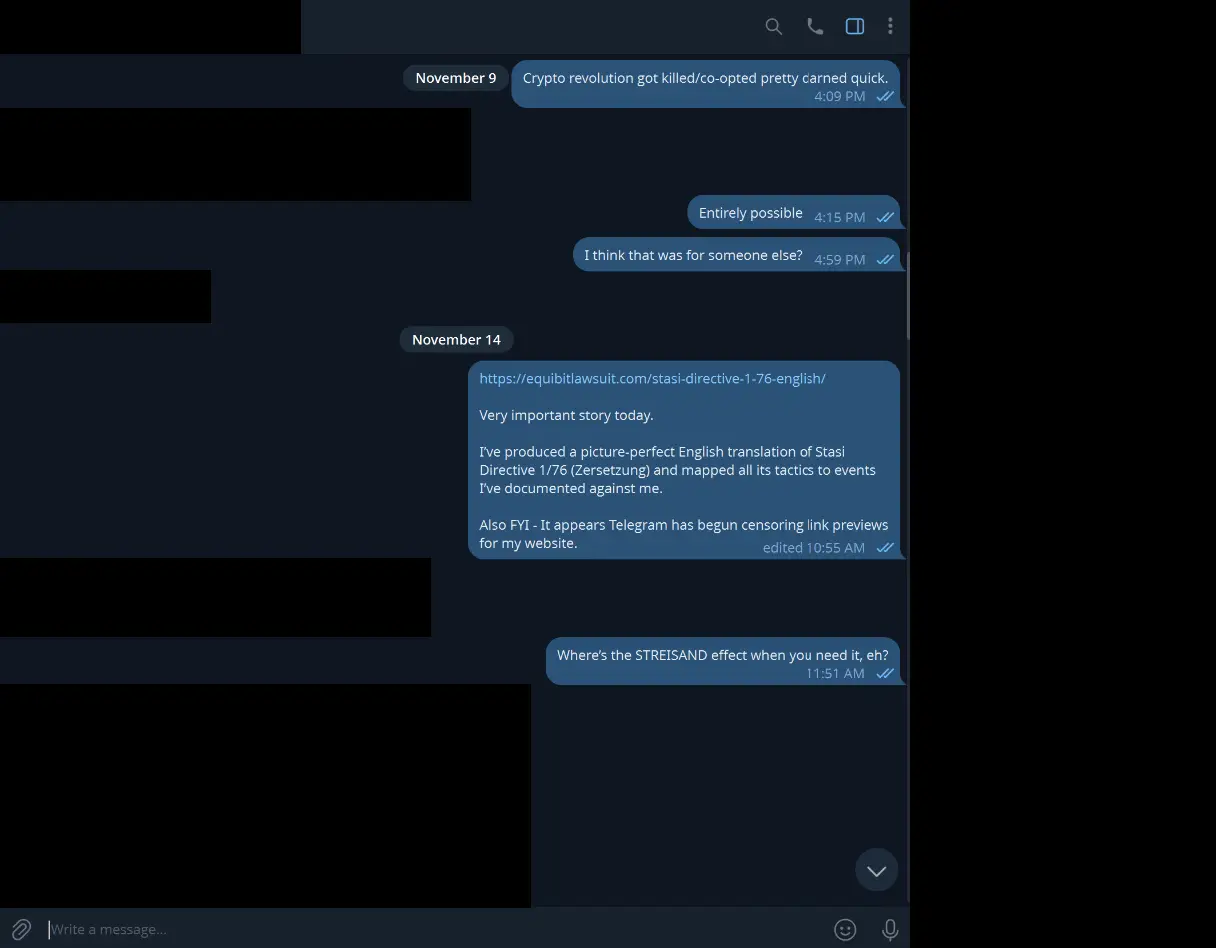
On 14 November, Horlacher shared the Directive post in the same private chat. No preview card appeared. He asked @WebpageBot to refresh that URL that afternoon, and the next day to refresh a cache-busted URL the host had already logged as HTTP 200. Each time the bot said the preview had been updated. No card appeared.
Ordinary explanations already off the table
Three ordinary explanations do not fit the log.
It is not a general Telegram outage. Previews of other sites still work, and Telegram’s own crawler fetched other posts on this site on 2, 4, 6, 9 and 16 November.
It is not a problem with the Directive post that every crawler would hit. WhatsApp still built a preview from links on this site when this was first checked, and our own control tests, presenting Telegram’s user-agent, were served the Directive page and its image with a complete Open Graph set — og:title, og:description, og:url, and og:image — and with twitter:card set to summary_large_image. The site’s robots.txt does not disallow any crawler.
It is not a missing-tag, image-format, or server-block problem. Hosting.com found a clean .htaccess file — no bot, user-agent or IP rules aimed at Telegram — no Telegram blocks in the Wordfence WAF, and no firewall blocks on Telegram’s published ranges. The Directive featured image is a WebP file, as were the images Telegram fetched and rendered on 9 November and 16 November.
The failure is specific to Telegram’s preview of one URL: /stasi-directive-1-76-english/.
Hosting.com’s search of these windows matched on the TelegramBot (like TwitterBot) user-agent. A request that used some other user-agent would not appear in these extracts. In the logs we have, from 2 November through the 16 November test window, no address in Telegram’s published ranges requested the Directive page under that user-agent, or under any other that the host returned.
What this does not show
The logs show that Telegram’s preview crawler retrieves other posts on this site and will not fetch the English translation of Stasi Directive 1/76. They show that the omission is not a fault of this server, of caching, or of missing markup. They do not show why.
This post does not allege a motive. It does not allege that a party to the litigation directed Telegram to withhold the preview. Equibit is not treating this as an eighth numbered technical attack. The event is being logged because it is a recorded interruption in how a public document on this site is shared.
An earlier Telegram decision
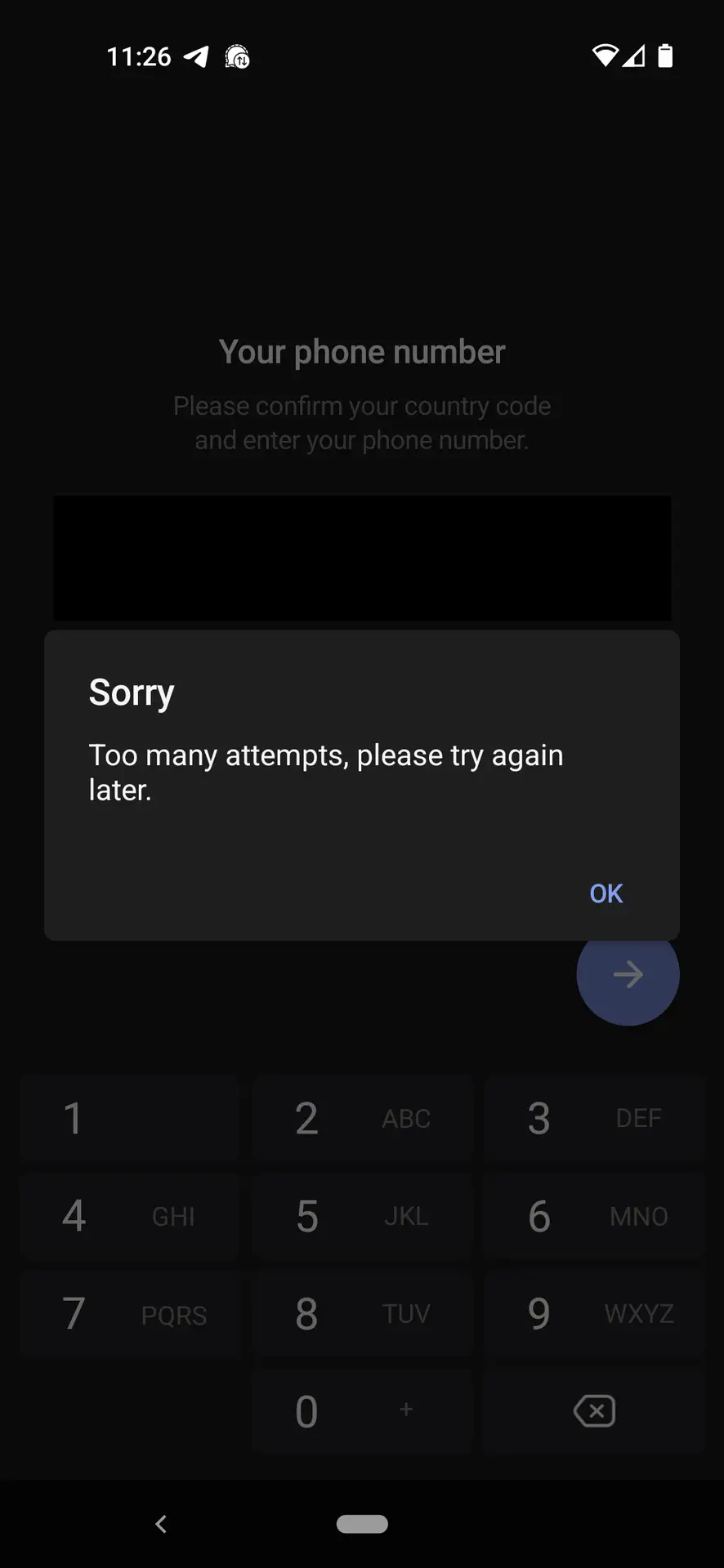
This is not the first time Telegram has cut off a channel that was carrying this record. In an update dated 09/01/2022 on The Assassination of Equibit, Horlacher wrote that “last night, without any warning, Telegram deleted the account and banned the phone number” he had been using to distribute that article.
On his account, he had been posting it to the Anarchapulco group and several Dollar Vigilante groups. It was one account, registered to a number that was not his. He says there was no termination notice and no route to appeal. Later attempts to re-register with that number were blocked.
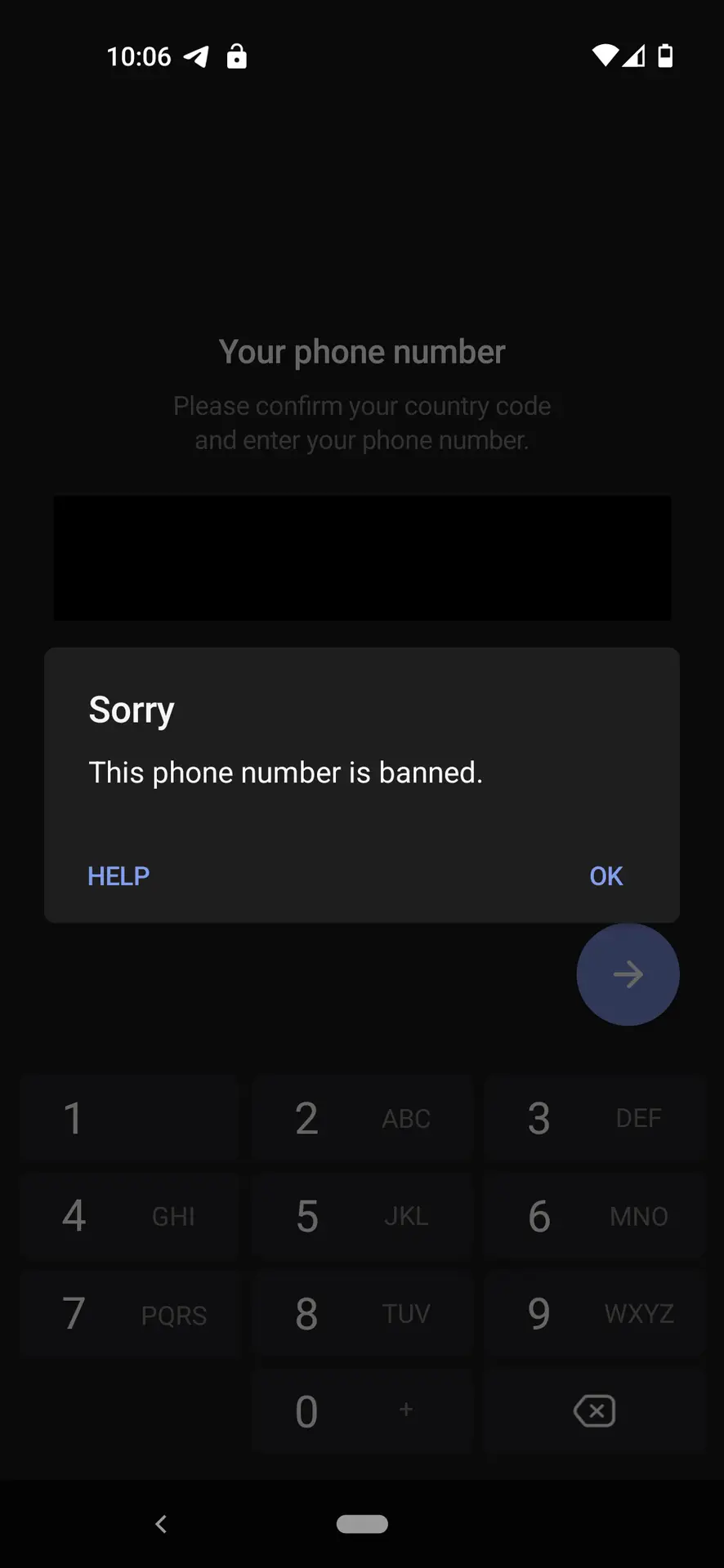
The November 2026 logs do not prove that the two decisions are connected, and they do not identify who, if anyone, asked Telegram to withhold this preview. Equibit’s position is that the 2022 termination is part of the context in which a later, URL-specific preview failure should be read. That is a position, not a finding.
Place in the Equibit Lawsuit
equibitlawsuit.com is the public record of Equibit Group Ltd.’s four Ontario Superior Court actions, including Court File No. CV-20-00645492-0000, Equibit Group Ltd. v. Attorney General of Canada et al. The post Telegram will not fetch is the English translation of Stasi Directive 1/76, the 1976 rulebook that describes Zersetzung. A Telegram preview is a small thing — a title, a short description, an image — but it is how a link to a post travels in that app. When the card is stripped, the pasted URL looks like an ordinary, untrusted string. The site itself stays up. That one page does not travel as the others do.
The event sits beside other documented interference with Equibit’s communications and public presence: the WhatsApp disruption at Anarchapulco in February 2026, the SEO poisoning of search results, and the request that Rebel.com suspend the site.
What we asked Telegram
These findings are being put to Telegram, with a request that it explain why its preview crawler fetches other posts on this domain and will not fetch /stasi-directive-1-76-english/, including after @WebpageBot reports that a preview was updated. This post will be updated when Telegram replies.
Further Reading
- The Stasi Playbook, Translated: Directive 1/76 and the Equibit File
- CSIS Secret Federal Court Warrants: Enabling Zersetzung Through Breaches of Candour
- CSIS and the Nuttall Case: What Was Reported and What the Court Record Shows
- CSIS Cryptocurrency Briefings: What the March 2026 Release Shows
- The Assassination of Equibit
- Seven Documented Technical Attacks Against Equibit and Chris Horlacher
- Targeted Communication Disruption: WhatsApp Call Block at Anarchapulco 2026
- SEO Poisoning: How Search Results Are Weaponized Against Targets
- Wosnack Asks Rebel.com to Suspend the Statement of Claim Page