

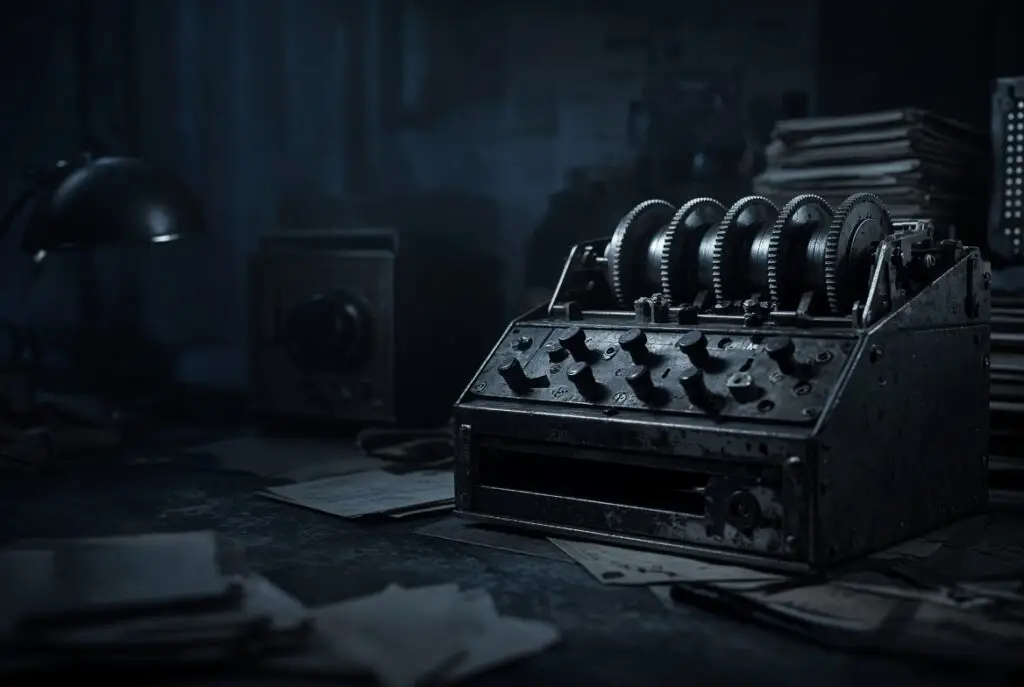
For more than half a century, governments trusted a Swiss company to protect diplomatic, military, and intelligence traffic. Crypto AG sold encryption machines, and later digital systems, to more than 120 countries. Customers included Iran, Argentina, Egypt, India, Pakistan, Latin American military governments, several NATO members, and the Vatican. They did not know the company was secretly owned and controlled by the Central Intelligence Agency, for many years in partnership with West Germany’s BND.
A classified CIA history, later obtained by The Washington Post and ZDF, called the arrangement “the intelligence coup of the century.” Foreign governments were, in the Agency’s words, “paying good money to the U.S. and West Germany for the privilege of having their most secret communications read.”
Origins: The Gentleman’s Agreement
The relationship began in the early 1950s. Crypto AG’s founder, Swedish engineer Boris Hagelin, had worked with American cryptologists during the Second World War. After the war he entered a “gentleman’s agreement” with U.S. officials, including William F. Friedman. Hagelin restricted the strength of machines sold to some countries and supplied stronger systems to others. The company received compensation and continued access to Western markets. That bargain was the seed of later control.
The Secret Purchase and Operation Rubicon
In 1970 the CIA and the BND bought Crypto AG through shell companies for about $5.75 million. The operation was first called Thesaurus, then Rubicon (Rubikon in German files). Inside the CIA the company was Minerva.
From then on the two services ran the important parts of the business: algorithm design, deliberate weaknesses, hiring and firing, and which customer received which version. Devices sold to target states contained engineered flaws. Traffic was readable by the CIA, NSA, and BND.
The take was large. At its peak, Crypto AG-derived material was a substantial share of the NSA’s usable intercepts from foreign governments. The United States read Iranian traffic during the 1979 hostage crisis, passed Argentine military traffic to Britain in the Falklands War, used Libyan communications after the 1986 Berlin discotheque bombing, and read a high share of Iranian traffic in the Iran-Iraq War. Some NATO and European buyers were compromised as well.
German Exit and Sole CIA Ownership
By the early 1990s the BND wanted out. After a Crypto AG employee was arrested in Iran in 1992, and after the Cold War ended, Germany sold its share. The CIA paid about $17 million and ran the company alone. Stronger commercial encryption was spreading. The Agency still kept the firm and still took what remaining customers sent, until Crypto AG’s assets were wound up in 2018.
Exposure, 2020
The record became public in February 2020 in a joint investigation by The Washington Post, ZDF, and Swiss SRF, built on an internal CIA history and a parallel BND account. The Swiss government opened an inquiry. The private buyers of the remaining assets said they had no continuing intelligence tie.
What the Record Establishes
Crypto AG is one of the cleanest documented cases of a Western service turning a trusted private technology company into a long-running collection platform. Large-scale compromise of communications gear, sustained for decades and written up in the agencies’ own files, is not a thought experiment.
Place in the Equibit Lawsuit
In late 2018 and early 2019, while Equibit Group was trying to keep the company alive from Zug, Horlacher walked past Crypto AG’s headquarters several times without knowing what the building was. The firm’s remaining assets were being wound up that year.
The Crypto AG file does not prove any allegation in Court File Nos. CV-20-00645492-0000, CV-21-00654929-0000, CV-26-00015305-0000, or CV-26-00017856-0000. It is on this site because Equibit Group Ltd. built peer-to-peer securities infrastructure and is now in court over alleged intelligence-linked interference with that company. The historical parallel is offered as context. It is not a finding.
Primary reporting: Greg Miller, “The intelligence coup of the century,” The Washington Post, 11 February 2020.