

In what is becoming a clear and predictable pattern across all four lawsuits (especially CV-20-00645492-0000), Wise (formerly TransferWise) has joined Revolut in abruptly de-banking Chris Horlacher and companies associated with him.
After successfully opening an account for his operating company and a personal account, Wise began requesting additional verification for his second, less active entity (an IP holding company that collects royalties). Once the trading address was updated to the current residential address in Mexico (as explicitly instructed by Wise support) and a utility bill was provided, all associated accounts were restricted within less than an hour, with a notice that they will be closed on October 7, 2026. Chris immediately filed an appeal, but it was thrown out by Wise in a matter of hours.
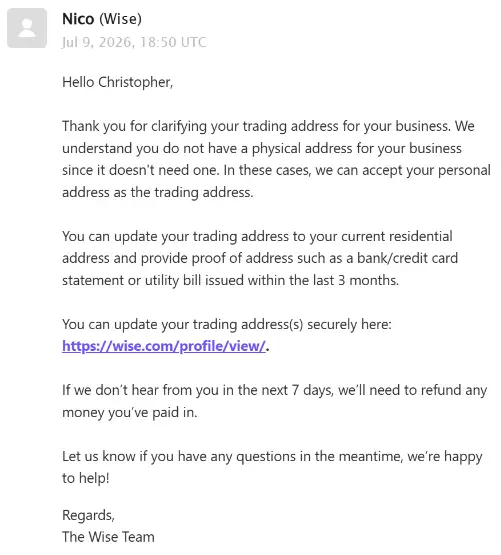
The stated reason? Vague language claiming activity “against our Customer Agreement.” Notably, the only “transaction” flagged by Wise was their own $31 account opening fee.
A Second Closure Notice — and an Email Address Never Used
On August 9, 2026, a new message arrived from Wise, this time addressed to an email at the equibit.org domain, the very first domain Equibit Group ever operated from (when it operated under the name Equibit Development Corporation) and one which was still under Horlacher’s control. The email stated that an account associated with that domain would be closed on 23 September 2026. The stated reason was the same formula used earlier: the way the account had been used went against Wise’s customer agreements.
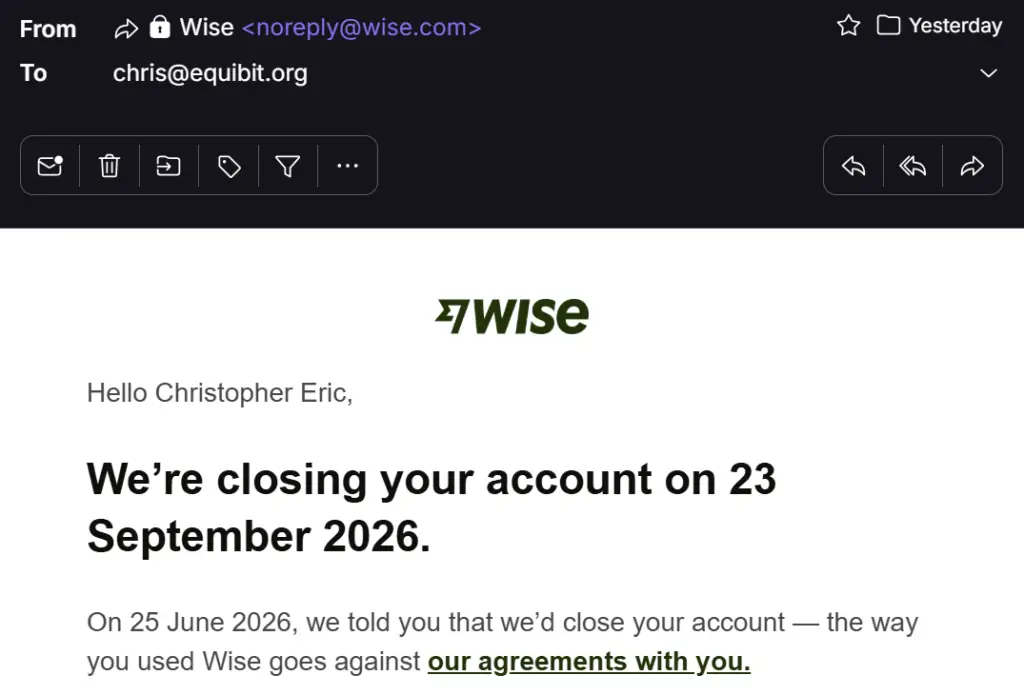
At the time the earlier accounts were created and then shut down, the equibit.org domain did not yet have complete email authentication (SPF, DKIM, and DMARC) in place, nor did it have any kind of email (MX records) settings applied, leaving it vulnerable to spoofing. Only weeks before the new closure notice arrived had those records been properly configured, which is why the message was now successfully delivered.
The timing raised a different question. Wise later said the equibit.org profile was Horlacher’s own, registered about ten years ago and verified with a Canadian ID. On 25 June 2026 it was deactivated within minutes of the new profiles being opened. The new profiles were allowed to proceed.
Formal Complaint and Wise’s Response
A formal request was sent to Wise Support asking for complete details of any account(s) registered under the equibit.org domain, including what identity documents had been submitted, and whether the earlier closures of the first set of accounts were connected to this second registration. The request also asked that, if the original accounts had been closed because of identity poisoning by a third party, those accounts be restored.
On 19 August 2026, Wise issued formal responses to the complaints filed regarding the closure of both the business accounts and the personal account.
In both letters, Wise:
- Denied any third-party access or unauthorised interference.
- Stated that an “older profile” associated with the same details was identified as a duplicate and closed.
- Cited sections 6.2 and 8.3 of their Customer Agreements (accuracy of information and acceptable use) without specifying what information was allegedly inaccurate.
- Refused to uphold the complaints.
A critical chronological problem remains unresolved. On 25 June 2026, before email DNS had been configured for the equibit.org domain, Wise sent a closure notice to chris@equibit.org. That address was not yet under active monitoring. The same day, Horlacher opened the company and personal profile under his horlacher.ca email and was let onto the platform. A duplicate-profile explanation does not answer why the dormant address was terminated in minutes while the new profiles were allowed to proceed.
A detailed follow-up was sent to Wise on the same day the complaint responses were received. It formally requested:
- An explanation of the origin of any profile or account linked to chris@equibit.org and the 25 June 2026 notice;
- Specific identification of the information or conduct said to breach the cited contractual sections; and
- Confirmation of whether any third-party applications using Equibit-related email addresses were detected.
Wise’s Final Response, 5 October 2026
On 5 October 2026 Shauna, a Complaints Officer at Wise, closed the internal complaint. Her letter is the reply to the 19 August follow-up. It does not identify a transaction, a false statement, or a document.
She writes that the old Equibit profile was registered about ten years ago and verified at the time with a Canadian ID matching Horlacher. She denies a recent third-party registration. She says that on 25 June 2026, when the new profile was approved, Wise’s systems flagged the older profile as a duplicate, deactivated it, and that deactivation automatically sent the closure notice. She calls this a standard action flowing from the new application.
The new profiles were opened that day. That part of the sequence is no longer in dispute. Horlacher opened a new profile on his personal email on 25 June 2026 and was granted immediate access, subject to constraints, while the file was under review. He then began setting up the LLC account and submitted a further application for the company that collects his book royalties.
What Shauna’s account does not explain is the split. If the system found the old profile, reviewed it, and terminated it within hours of the new application, Wise still let the horlacher.ca profiles proceed for weeks. Those profiles were restricted later, within an hour of a trading-address update Wise’s own support had requested, with a closure date of 7 October 2026. The equibit.org address received a further notice on 9 August 2026. An automatic duplicate rule that fires on one profile and sleeps on the others is not an answer.
Nor is there use to review. No customer transaction was made on the old profile or the new ones. The only movement Wise has flagged remains its own $31 account opening fee. Sections 6.2 and 8.3 are cited again. The inaccurate information is not named. The prohibited use is not named. Shauna writes that regulation bars Wise from disclosing the flags. She confirms a review of the business-account onboarding documents, denies takeover or spoofing on Wise’s platform, and says the decision to keep the accounts closed is final. She points to an ombudsman.
The ombudsman is not the next step. Wise has closed its file without producing what it relied upon. The next step is an application for a Norwich order compelling production of the records behind both closures, the equibit.org profile and the horlacher.ca profiles. The 5 October letter is preserved with the rest of the correspondence.
On 5 October 2026 Horlacher replied to Shauna, with counsel copied. The reply rejects the ombudsman path and asks Wise to produce the records relied on for both closures, or to confirm the refusal and the legal provision. A Norwich application is the step if Wise does not produce them.
This Is Retaliatory Financial Isolation
This is not simple “risk management.” It is part of a broader campaign of financial isolation — the systematic denial of banking and payment services to pressure, punish, and neutralize a target. In legal terms, this pattern raises serious concerns including:
- Economic Duress / Coercion — Using control over essential financial services to pressure someone into dropping legitimate legal action against the state.
- Tortious Interference with Economic Relations — Intentionally disrupting a person’s ability to conduct business and receive income without lawful justification.
- Retaliation for Exercising Charter Rights — Particularly freedom of expression and the right to access the courts.
When multiple financial institutions take similar actions in close succession, it suggests coordinated de-risking based on external pressure rather than genuine compliance concerns.
Core Legal Concepts
Financial isolation (sometimes called financial exclusion or de-risking) is not a single, universally codified legal term, but it is increasingly recognized in legal, human rights, and regulatory contexts as a form of economic coercion or constructive denial of basic rights.
Financial Exclusion / De-Risking
In regulatory terms, this refers to the practice by banks and financial institutions of terminating or refusing relationships with certain customers to reduce perceived risk (reputational, regulatory, or financial). While institutions have the right to manage risk, when done systematically and without due process against protected classes or in retaliation for protected activities, it can cross into illegal territory.
Economic Duress / Coercion
In civil law (including Ontario and Canadian common law), financial isolation can be viewed as a form of economic duress if it is used to pressure someone into dropping legal action or remaining silent.
Tort of Unlawful Interference with Economic Relations
Canadian courts have recognized claims where defendants (including banks) intentionally interfere with a plaintiff’s economic interests through unlawful means. Systematic de-banking across multiple institutions could potentially support such a claim if it can be shown to be coordinated or retaliatory.
Human Rights Angle
- International Covenant on Economic, Social and Cultural Rights (Canada is a signatory) recognizes the right to an adequate standard of living, which includes access to banking services in modern society.
- UN Guiding Principles on Business and Human Rights increasingly view arbitrary financial exclusion as a potential human rights violation, especially when it targets journalists, activists, or litigants against the state.
What This Means
In a modern economy, access to banking and payment rails is not a luxury — it is a basic necessity. Systematic financial isolation effectively creates a form of civil death, making it extremely difficult to work, receive income, sustain legal action, or simply exist.
This tactic mirrors historical authoritarian methods of control, updated for the digital age. It is particularly concerning when deployed against someone actively litigating against a national intelligence agency.
Chris Horlacher’s case continues to serve as a public test of whether basic financial access and rule of law still exist for Canadian citizens who dare to hold their own government accountable.
October 2026 Update – Wise’s Final Position
On 19 October 2026 Shauna of Wise’s Complaints Team replied to Horlacher’s 5 October letter. The reply describes itself as Wise’s final position and says it concludes Wise’s internal complaints process.
The letter says that, as a regulated financial institution, Wise is “legally and operationally restricted from disclosing the specific internal records, system flags, or exact verification outcomes that result in an account deactivation.” It does not name the statute, regulation or regulator imposing that restriction. The 5 October reply had asked Wise to identify that legal provision if it refused to produce the records.
Since 28 April 2026, regulation 51B of the UK Payment Services Regulations 2017, as substituted by S.I. 2025/688, has required a payment service provider terminating an indefinite framework contract entered into on or after that date to give a notice that contains “an explanation of the reasons for termination which is sufficiently detailed and specific to enable the payment service user to understand why the framework contract is being terminated,” at least 90 days before termination. The profiles were opened on 25 June 2026. The regulation yields only where another legal requirement conflicts with it, and regulations 51C and 51D list the specific grounds on which notice may be shortened or dispensed with. Wise’s 19 October letter cites none of them.
Section 6.2 of the Terms of Use, which requires information provided to Wise to be “complete, accurate, and truthful,” is cited a third time. The letter again does not say what information was incomplete, inaccurate or untruthful. It states that the profiles “were deactivated correctly as a direct result of our onboarding and verification assessments” and that Wise’s security teams “have ruled out any third-party interference or identity spoofing.” It does not say how that second conclusion was reached.
The letter does not address the sequence set out above. The equibit.org profile was terminated within minutes on 25 June 2026. The horlacher.ca profiles were allowed to proceed for weeks, then restricted within an hour of an address update Wise’s own support had requested.
Wise states that it “will not be providing further internal operational data or verification records.” It acknowledges Horlacher’s intention to instruct counsel to seek a Norwich order and says it respects his right to pursue the matter through civil proceedings. The 19 October letter is preserved with the rest of the correspondence.