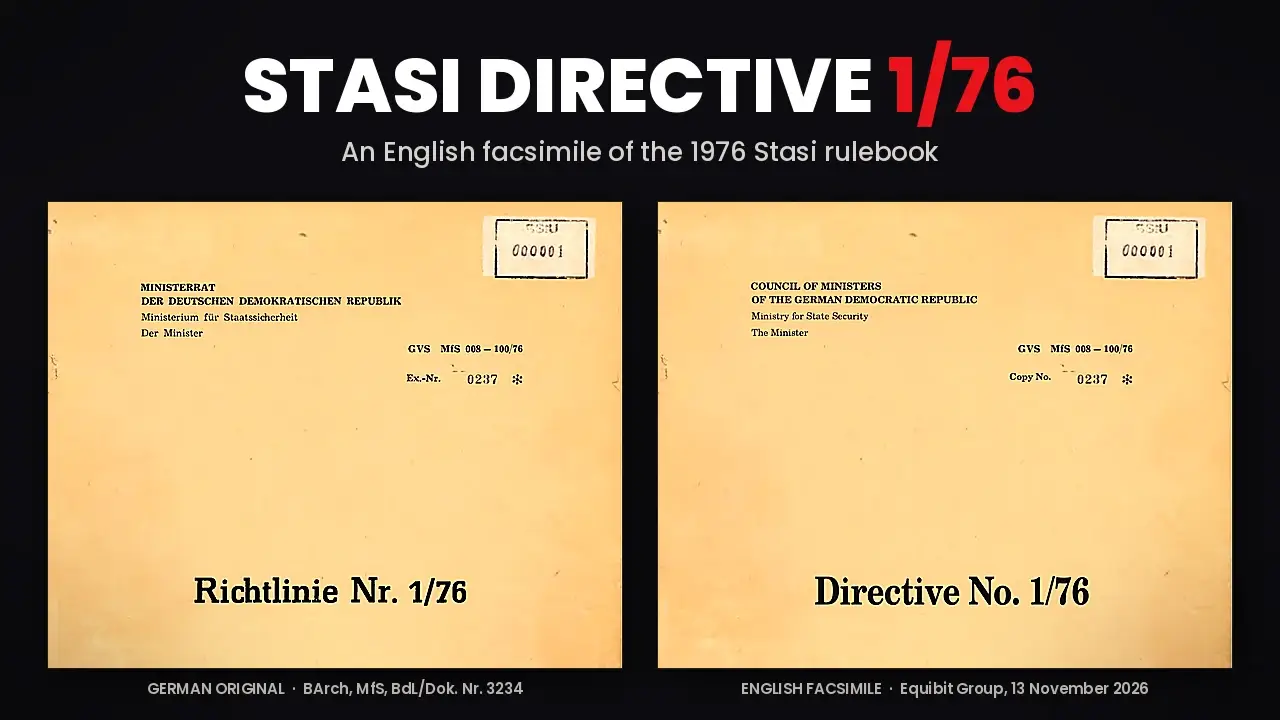


Court File No. CV-20-00645492-0000
Equibit Group Ltd. v. Attorney General of Canada et al.
Related: Seven Documented Technical Attacks · WhatsApp block at Anarchapulco 2026 · Wosnack Statement of Claim
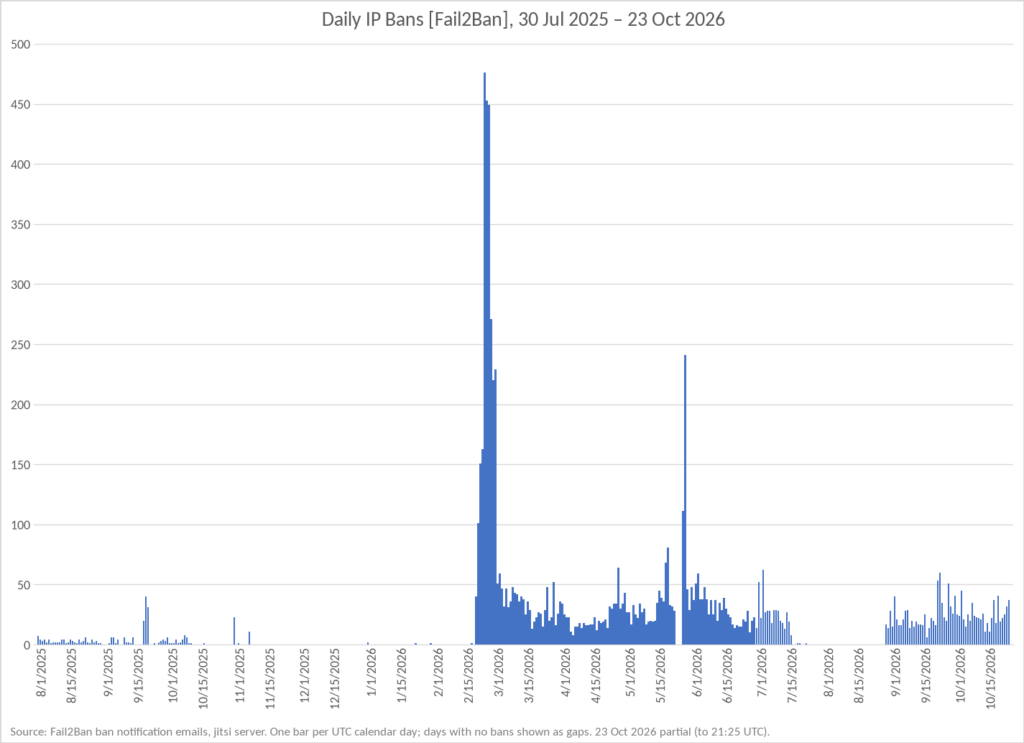
In late July 2025 Equibit Group Ltd. deployed a private Jitsi Meet instance for encrypted video conferences with legal counsel. Fail2Ban was set to ban any IP after five failed SSH authentications and to email a notice for every ban. The Fail2Ban Jitsi logs in that mailbox run from 30 July 2025 to 23 October 2026: 8,475 ban events.
Equibit Group’s position is that those logs record three distinct waves of SSH brute force, each separated from the next by a silence. Wave 1 began on 16 February 2026, peaked in the week of Anarchapulco, and ran to 21 May. After four days without a single ban, Wave 2 opened with a spike on 25–26 May and ran to 14 July. After a 44-day silence, Wave 3 began on 27 August 2026 — the period in which the company was preparing Court File No. CV-26-00017856-0000 against Nathan Wosnack and Ubitquity, LLC, which issued on 8 September 2026. Wave 3 has run every day since.
This article is a quantitative pass over the three waves and the silences between them. It does not assign the packets to a named operator.
Methodology
Daily ban counts were taken from the Fail2Ban notification emails, one email per ban. Each count is a ban event, not a distinct address: the same address can be banned more than once. Daily counts use UTC calendar days; clock times are Central time (UTC−6).
A wave is a run of sustained daily bans: it starts with the first ban after a silence of at least four days and ends with the last ban before the next silence. Before 16 February 2026 bans were sporadic and are treated as background, not as a wave. Each wave is screened on its own: mean daily bans over the days with at least one ban, the standard deviation, and a two-standard-deviation (2σ) threshold. Any day above that threshold is flagged as an anomaly under a normal-distribution rule of thumb. The distributions are right-skewed. The rule is a flag, not a proof of cause. The day still in progress at the cut-off (23 October 2026) is excluded from the Wave 3 screen.
| Period | Dates | Ban events | Days with bans | Mean per day | Peak day | 2σ threshold | Days above |
|---|---|---|---|---|---|---|---|
| Before the waves | 30 Jul 2025 – 28 Jan 2026 | 298 | 67 of 183 | 4.45 | 18 Sep 2025 (40) | 17.88 | 4 |
| Silence | 28 Jan – 16 Feb 2026 | 0 | — | — | — | — | — |
| Wave 1 | 16 Feb – 21 May 2026 | 4,999 | 94 of 95 | 53.18 | 22 Feb 2026 (476) | 225.48 | 5 |
| Silence | 21 – 25 May 2026 | 0 | — | — | — | — | — |
| Wave 2 | 25 May – 14 Jul 2026 | 1,749 | 51 of 51 | 34.29 | 26 May 2026 (241) | 102.39 | 2 |
| Silence | 14 Jul – 27 Aug 2026 | 3 | 3 of 43 | — | — | — | — |
| Wave 3 | 27 Aug – 23 Oct 2026 | 1,426 | 58 of 58 | 24.37 | 21 Sep 2026 (60) | 46.10 | 3 |
| Total | 30 Jul 2025 – 23 Oct 2026 | 8,475 |
Monthly totals, split at the wave boundaries:
| Period | Ban events | Phase |
|---|---|---|
| 30 Jul – 30 Sep 2025 | 230 | Before the waves |
| Oct 2025 | 53 | Before the waves |
| Nov 2025 | 11 | Before the waves |
| Dec 2025 | 2 | Before the waves |
| Jan 2026 | 2 | Before the waves |
| 16–28 Feb 2026 | 2,605 | Wave 1 |
| Mar 2026 | 1,021 | Wave 1 |
| Apr 2026 | 693 | Wave 1 |
| 1–21 May 2026 | 680 | Wave 1 |
| 25–31 May 2026 | 563 | Wave 2 |
| Jun 2026 | 832 | Wave 2 |
| 1–14 Jul 2026 | 354 | Wave 2 |
| 15 Jul – 26 Aug 2026 | 3 | Silence |
| 27–31 Aug 2026 | 114 | Wave 3 |
| Sep 2026 | 742 | Wave 3 |
| 1–23 Oct 2026 | 570 | Wave 3 |
Before the Waves — July 2025 to January 2026
From the first ban on 30 July 2025 to 28 January 2026 the server logged 298 bans on 67 of 183 days, a mean of 4.45 on the days with bans. The busiest day was 18 September 2025 (40). Activity then fell away: 53 bans in October 2025, 11 in November, 2 in December, 2 in January, with no bans at all from 6 November to 29 December 2025. Addresses returned on later days: two Chinese addresses were each banned at least ten times between July 2025 and March 2026.
After a ban at 14:38 on 28 January 2026, the server logged nothing for 18 days.
Wave 1 — 16 February to 21 May 2026
Wave 1 opened with a single ban on 16 February 2026. On 18 February the server logged 40 bans, then 101, 151 and 163 on the following three days, before the peak. The wave screen (mean 53.18, threshold 225.48) flags five days:
| Rank | Date | Ban count | Multiple of wave mean |
|---|---|---|---|
| 1 | 2026-02-22 | 476 | 9.0× |
| 2 | 2026-02-23 | 453 | 8.5× |
| 3 | 2026-02-24 | 449 | 8.4× |
| 4 | 2026-02-25 | 271 | 5.1× |
| 5 | 2026-02-27 | 229 | 4.3× |
26 February (220) sits just under the threshold. The extreme window is 22–27 February 2026: 220 to 476 bans a day. February 2026 alone produced 2,605 bans, all of them from 16 February on. The wave then settled into a steady spring: 1,021 bans in March, 693 in April and 680 from 1 to 21 May, with a late rise on 17 and 18 May (68 and 81). The last ban of Wave 1 came at 11:53 on 21 May 2026.
February 2026 and Anarchapulco
The February surge sits on the same week as Anarchapulco 2026, where Chris Horlacher was speaking and meeting counsel and journalists. On 18 February 2026 he also recorded a targeted WhatsApp failure to his wife at the conference. That incident is on the technical-attack chronology.
Equibit Group’s position is that volume and duration in that week are a poor match for idle internet scanning of a private counsel server that advertised nothing. The surge came after four near-silent months and an 18-day silence.
Technical Characteristics, July 2025 to May 2026
The logged vector was SSH brute force against sshd. Source IPs were spread across geographies and ASNs, with a large share from Chinese address space, cloud hosts, and residential proxies — the usual rented or compromised pool.
Jitsi itself kept running. A loud SSH grind against a hardened box can be the campaign, or it can be noise around another objective. The logs do not settle that question.
Cycling hundreds of addresses a day against a single low-value host for several days is not free. Commercial proxy and botnet prices for a burst of that length sit in the low-to-mid thousands of dollars on public rate cards. That is above casual scanning. It is not, by itself, a named defendant.
The May Gap — 21 to 25 May 2026
Between the last ban of Wave 1 at 11:53 on 21 May 2026 and the first ban of Wave 2 at 13:10 on 25 May, the mailbox holds no ban notices: 4 days, 1 hour and 17 minutes. 22, 23 and 24 May are zero-ban days in both UTC and Central time.
The silence is not a mail outage. Through those same days the server’s other automated reports — the daily virus scan, the rootkit check and the package-update notices — arrived on schedule through the same relay. The Fail2Ban sshd jail sends a notice every time it starts. The mailbox holds a start notice on 20 May and the next one on 29 May; none falls inside the gap. Bans resumed on 25 May without a jail restart.
Wave 2 — 25 May to 14 July 2026
Wave 2 opened at 13:10 on 25 May 2026 with 111 bans that UTC day and 241 the next — the largest day outside February. The wave screen (mean 34.29, threshold 102.39) flags exactly those two opening days.
From 27 May to 14 July the wave held at 1,397 bans, about 28.5 a day — close to the Wave 1 spring rate — and tapered in July. The last ban of Wave 2 came at 09:48 on 14 July 2026. In total Wave 2 logged 1,749 bans and recorded at least one ban on every one of its 51 days.
The Summer Silence — 14 July to 27 August 2026
From 15 July to 26 August 2026 the mailbox holds three bans: 17, 18 and 21 July. Each came 37 to 40 minutes after a restart of the sshd jail. One of the three, 77.83.39.238 on 17 July, reappears in Wave 3. The jail restarted again on 28 and 31 July and on 6, 11, 19 and 26 August; none of those restarts was followed by a ban. Between the 21 July ban and 27 August — 37 days — the mailbox holds no bans. From the end of Wave 2 to the start of Wave 3 the silence lasted 43 days and 22 hours.
Wave 3 — 27 August 2026 to Date
Fail2Ban again began recording bans at 07:51 on 27 August 2026. From then to 15:25 on 23 October 2026 the server logged 1,426 ban events, with at least one ban on every day. The first twelve days, 27 August to 7 September, produced 266 bans.
That date sits immediately before issuance of Court File No. CV-26-00017856-0000, Equibit Group Ltd. and Chris Horlacher v. Nathan Wosnack and Ubitquity, LLC, on 8 September 2026. Preparation of that claim was underway in late August.
The wave screen, run on the 57 full UTC days from 27 August to 22 October 2026 (1,389 bans; mean 24.37, standard deviation 10.85, threshold 46.10), flags three days:
| Date | Ban count | Multiple of wave mean |
|---|---|---|
| 2026-09-20 | 53 | 2.2× |
| 2026-09-21 | 60 | 2.5× |
| 2026-09-25 | 51 | 2.1× |
Counted in Central-time days (threshold 45.8), 1 October (50) also crosses the threshold; in UTC days it holds 45.
In the 30 days to 23 October 2026 the server logged 794 bans, about 26.5 a day, against 632 in the 30 days before — an increase of about 26 percent. Those 794 bans came from 793 distinct addresses. Unlike 2025, addresses almost never return.
Patterns in Wave 3 (hour and attempt figures cover the last 30 days):
- Coordinated bursts, 1 October 2026: at 10:01 and 17:26 (Central time), 33 addresses from a single block, 77.83.39.0/24 (LANEDONET, Netherlands), were banned in two bursts of 17 and 16. One of them, 77.83.39.238, was also among the three bans of 17 July 2026.
- Burst, 17 October 2026: 24 bans inside one hour, from 18:13.
- Slow, low-rate attempts: from 18:32 on 17 October, 213.209.159.242 (FeoPrest SRL block) tried one login roughly every 30 to 40 minutes — at least 72 failed passwords in the first 22 hours of log lines in its notice — and was banned only at 15:25 on 23 October. Two other addresses in the same block were banned on 22 October at 14:52 and 18:26.
- Peak hours (Central time): 10:00 (83 bans), 18:00 (57), 21:00 (44), 17:00 (43).
- Attempts before ban: 734 of 794 bans came at exactly five attempts, 54 at six, six at seven to nine.
Where the last 30 days of addresses are registered:
- Countries: United States 148, China 146, Netherlands 45, Hong Kong 44, Indonesia 39, Singapore 38, Vietnam 33, India 29, South Korea 28, Brazil 23, Germany 22.
- Regional registries: APNIC 341 (including KRNIC), ARIN 237, RIPE NCC 139, LACNIC 52, AFRINIC 23.
- Networks: ByteDance cloud (Volcano Engine and BytePlus) 52, Tencent Cloud 39, Microsoft Azure 38, LANEDONET 33, UCloud 32, China Telecom 31, Alibaba Cloud 24, Baidu 23, Oso Grande IP Services 20, DigitalOcean 19, OVH 17.
- Cloud and hosting: at least 30 percent of the 794 bans trace to named cloud providers, before counting smaller hosting firms.
Usernames tried in a sample of 37 full notification emails include root (by far the most frequent), ubuntu, git, deploy, sysadmin, openvpn, splunk, frappe and ollama. None of the sampled emails shows a successful login.
Place in the Equibit Lawsuit
The Jitsi host was built for counsel calls in the CSIS action, Court File No. CV-20-00645492-0000. The logs belong on the technical-attack record with the router, DNS, and WhatsApp incidents in Seven Documented Technical Attacks. Wave 3 is contemporaneous with the Wosnack filing.
Conclusion
The Fail2Ban mailbox is one of the cleaner quantitative sets in this file: near-silence from October 2025 to January 2026; Wave 1 from 16 February, peaking in the week of Anarchapulco and a comms failure; a four-day stop in late May; Wave 2 opening with a two-day spike and running to 14 July; a 44-day silence; then Wave 3 from 27 August as a fourth Ontario action was being prepared — running daily since, with coordinated bursts from single network blocks. The packets do not name an operator. They do name a clock.