
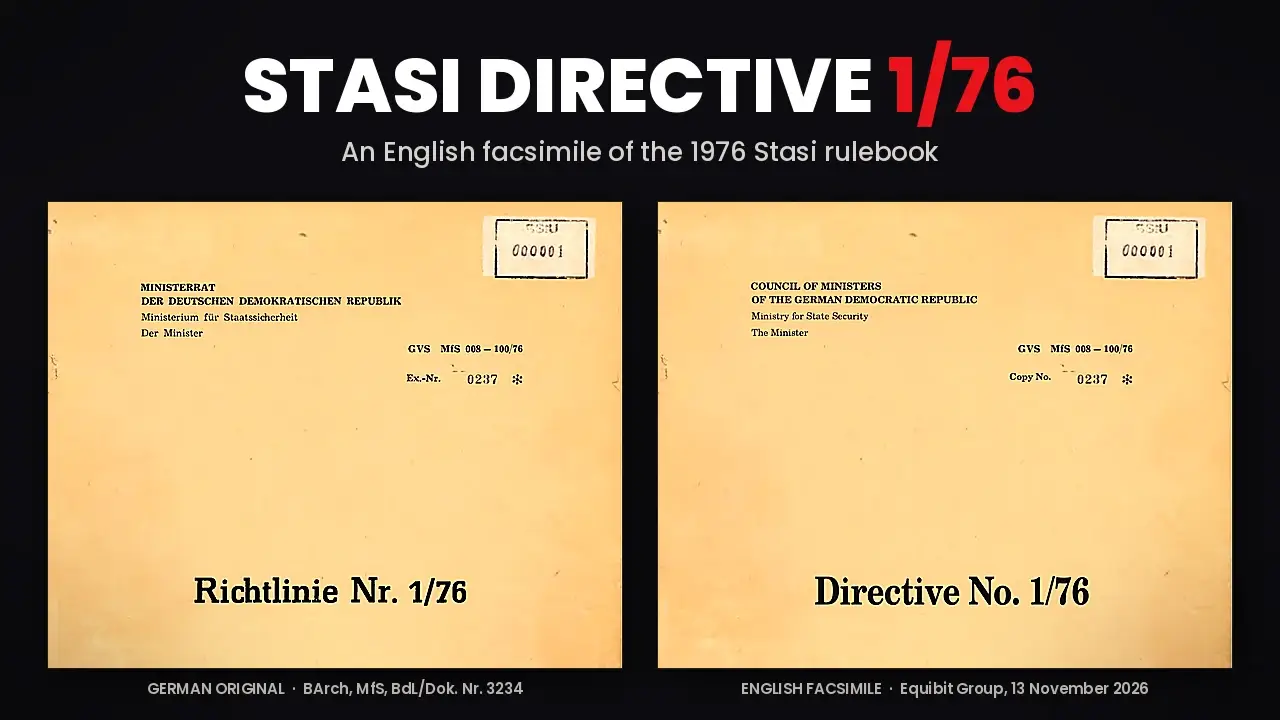
In January 1976, Erich Mielke, East Germany’s Minister for State Security, signed a secret rulebook for his officers. It was called Directive No. 1/76, and it explained how the Stasi should open, run and close an “Operational Case” against a person it had decided was a problem.
The Stasi archive in Germany still holds the original, under reference BArch, MfS, BdL/Dok. Nr. 3234. We have translated it into English, page for page, and the full PDF is attached at the end of this post. Each quote below gives the section number and the page of our translation (“p.”) so you can check it yourself.
This post reads that rulebook next to what has happened to Equibit Group and its founder, Chris Horlacher. The allegations described here are pleaded in four Ontario lawsuits. Where a document backs a point, we link it. Where something is Equibit’s own view or inference, we say so.
What the Stasi meant by “hostile-negative”
One phrase runs through Directive 1/76 from start to finish: feindlich-negativ, or “hostile-negative”.
The Directive opens by saying that the point of an Operational Case is that “the effectiveness of hostile-negative forces is above all to be prevented preventively” (Preamble, p. 7). In other words, stop people before they become effective.
The targets were not limited to people who had broken a law. Officers were told to go after “hostile-negative acts, influences and dangers, as well as other phenomena that disrupt and impede social development” (§1.1, p. 8). Their informants were to track “political-ideological diversion”: “which means and methods are applied”, “through which channels it becomes effective” and “who belongs to its bearers and disseminators” (§1.2.1, p. 11).
The Directive is blunt about lawful conduct. Officers had to watch for “those hostile-negative acts that the enemy deliberately keeps below the threshold of criminal-law relevance” (§1.2.1, p. 12). Informants were to report “on the dissemination of revisionist and anti-socialist theories” and “on statements and reactions pointing to hostile-negative attitudes and aims” (§1.5, p. 19).
So the Stasi did not need violence, a weapon or a crime. Spreading the wrong ideas was enough. Its harshest tool, Zersetzung (“decomposition”), could be aimed “against persons, groups of persons and organizations from which activities emanate for spreading or intensifying political-ideological diversion” (§2.6.1, p. 46).
2011: a booth, a body of ideas, and a stranger
In 2011, Chris Horlacher was CFO of Euro Pacific Canada and had begun volunteering with the newly formed Mises Institute of Canada. He later served as its Treasurer and Vice-Chairman and led work on an accredited continuing-education program (The Disappearance of Redmond Weissenberger).
The Institute’s work was peaceful public education in Austrian Economics: Ludwig von Mises, Friedrich Hayek and the free-market school that stresses sound money, private property and the limits of central planning. That school was pushed out of mainstream academic economics, and economists and historians of economic thought have documented how.
The gap is striking because the school sits at the root of modern economics. Its founder, Carl Menger, published Principles of Economics (Grundsätze der Volkswirtschaftslehre) in Vienna in 1871. Historians credit that book, together with William Stanley Jevons’s of the same year and Léon Walras’s of 1874, with starting the “marginal revolution”: the idea that value comes from how much people care about the last unit of a good, not from the labour that went into it (Fraser Institute, The Essential Austrian Economics). The term “marginal utility” itself (Grenznutzen) was coined in 1884 by Menger’s student Friedrich von Wieser (ENS Lyon). Students meet marginal utility in their first weeks, but as calculus in the tradition of Jevons, Walras and Alfred Marshall, and Menger, who refused to use mathematics, is rarely credited. Introductory texts give the history almost no room: a 2011 NYU Stern honours study of twelve leading principles textbooks found that eleven devoted no space at all to the history of economic thought (Bourchtein, 2011). Where the history is told, the historian William Jaffé wrote, the habit of “lumping Menger, Jevons and Walras together under one caption has grossly distorted the history of their contributions” (Jaffé, Economic Inquiry, 1976).
Hayek’s Nobel Prize gets the same treatment. He shared the 1974 Nobel Memorial Prize in Economic Sciences with Gunnar Myrdal “for their pioneering work in the theory of money and economic fluctuations and for their penetrating analysis of the interdependence of economic, social and institutional phenomena” (NobelPrize.org). The Academy’s press release singled out “his theory of business cycles and his conception of the effects of monetary and credit policies”. It said Hayek “showed how monetary expansion, accompanied by lending which exceeded the rate of voluntary saving, could lead to a misallocation of resources”, and that he was “one of the few economists who gave warning of the possibility of a major economic crisis before the great crash came in the autumn of 1929” (press release, 9 October 1974). That is Austrian Business Cycle Theory. It traces booms and busts to new money and credit created by the monetary authority, which in most countries today is the central bank (Boudreaux, The Essential Hayek, ch. 7). In other words, the theory puts the source of the business cycle in the government’s own monetary system. Hayek is usually introduced as the author of The Road to Serfdom. The business-cycle work the Nobel committee actually named rarely comes up.
The careers of the school’s leading figures show how it was pushed aside. Mises never held a regular salaried professorship in Austria or the United States. In Vienna he taught for two decades as an unpaid Privatdozent after the university refused him a paid post (Raisons politiques, 2018). At New York University he was a “visiting” professor for more than twenty years, with his salary paid from private funds rather than by the university (Hülsmann, Mises: The Last Knight of Liberalism). When Hayek moved to the University of Chicago in 1950, its Department of Economics “showed little interest in hiring him”. He went instead to the interdisciplinary Committee on Social Thought, with his salary funded by an outside charity, the William Volker Fund (Caldwell and Klausinger, Hayek: A Life 1899–1950, as summarised in this King’s College London review).
PhD economists describe the result. Peter Boettke, Christopher Coyne and Patrick Newman write that in America in the 1950s and 1960s “the Austrian school could barely be maintained within the academic world”, and that many of its scholars held posts outside PhD-granting institutions, so they “could not supervise graduate students” (Boettke, Coyne and Newman, “The History of a Tradition: Austrian Economics from 1871 to 2016”). Nicolai Foss, who is critical of the school, agrees: Austrian economics “does not get published in high-prestige journals and Austrian economists are not employed by top universities” (Foss, “Austrian Economics: A Tale of Lost Opportunities”, 2019). The graduate programs these economists name as homes for the tradition, George Mason, Auburn and, historically, NYU, are all in the United States. Standard PhD training is built around mathematical modelling and econometrics, and the history of economic thought, “a field which used to be a part of every economist’s training”, “has unfortunately been marginalized” (Smith, Review of Austrian Economics, 2023). A student can finish a mainstream economics PhD, in Canada or elsewhere, without ever being taught Mises or Hayek’s work on money, capital and the business cycle.
That same year, at a Mises Institute of Canada booth at a Cambridge House resource-investment conference, a man named Marc Godard walked up and introduced himself. He went on to co-found Equibit with Chris, served as its technology chief and later its CEO, and was best man at Chris’s 2015 wedding. Godard lives in London, Ontario. Sources: The Marc Godard Revelation; Godard Statement of Claim, ¶¶9, 17–18; The Widow’s Son.
Equibit’s position is that the timing is not a coincidence. A security service with an ideological mission, like the Stasi, would see a group of people popularising Austrian Economics as a “hostile-negative” force: no violence, just ideas the state did not want spreading. Equibit alleges that Godard was a long-term intelligence asset placed close to Chris from that first meeting. That view is set out in The Marc Godard Revelation and in Chris’s Memo Re Marc Godard Experience. The lawsuit against Godard pleads breach of duty, intrusion and a takeover attempt. The CSIS link is Equibit’s position, not a court finding.
Chris’s memo records that it was Godard who, in 2014, “pushes for another business idea of mine and was interested in Equibit”. Equibit’s position is that encouraging Chris to build Equibit is what led him into the token sale, and from there into the Ontario Securities Commission’s sights (see Step two).
Here is how the rest of the Directive lines up.
Step one: pick a “focal area”
Directive 1/76 tells officers to concentrate on “focal areas”, meaning the sectors and people “at the centre of expected hostile attacks” (§1.1, p. 8).
Cryptocurrency was one of CSIS’s. In January 2018 The Canadian Press reported on a top-secret CSIS paper, prepared for a November 2016 deputy ministers’ meeting, that listed blockchain and cryptocurrencies among the “mega trends” on the service’s radar. In March 2026 CSIS released a SECRET assessment from February 2018 titled “Alternative Means of Funding: The Extreme Right and Cryptocurrency” (CSIS Cryptocurrency Briefings).
In those same years, Equibit was a federally supported Toronto startup building blockchain infrastructure for issuing and trading securities (Statement of Claim Against CSIS). In other words, it was a sound-money crypto company run by an Austrian-school advocate.
Step two: an anonymous tip, and the regulator
Under the Directive, a case can open on thin material. “it is not necessary for verified information and evidence to be available on all objective and subjective circumstances of the offence” (§1.8.2, p. 28). Tips from “state and economic management bodies, enterprises … and from citizens” all count (p. 28).
In early 2017, soon after Equibit had voluntarily asked the Ontario Securities Commission whether its EQB token was a security, OSC staff told the company on a recorded call that they were acting on an “anonymous tip”. The OSC then directed Equibit to complete its token sale, and later began an enforcement action against Equibit for that same sale (The OSC Experience; OSC Experience memo).
Equibit’s position is that the tip came from CSIS (The Assassination of Equibit). Either way, the pattern is in the Directive. Officers are told to use the “possibilities of the state and economic management bodies” against a target (§1.7.2, p. 24). One listed Zersetzung method is “summoning persons to state offices or social organizations on credible or implausible grounds” (§2.6.2, p. 47).
Step three: insiders
The Directive leaves no doubt about where its strength lies: “The main forces for the handling of Operational Cases are the IM” (§2.3, p. 32). An IM was an unofficial collaborator. The goal was to bring them “into contact with the suspected persons with the objective of gaining their confidence” (§2.3.3, p. 35). Once that was done, officers were to “consolidate the confidence of the suspected persons in the introduced IM”. Through the IM’s conduct and staged situations, “facts are to be created vis-à-vis the suspected persons which they, in their own terms, regard as proofs of reliability and trustworthiness” (§2.3.3, p. 36).
Godard’s return. Godard resigned from Equibit on or about 14 August 2017, six months into the token pre-sale. Chris’s memo says the timing was “just in time to avoid the OSC’s onslaught”. He came back as a contractor on or about 28 June 2018. The memo places that “just after we concluded our dealings with the OSC”, at the moment the company was losing its lead developer (see below). He served as CEO from 1 December 2018 to 1 April 2019 while the company was wound down (Godard Statement of Claim, ¶¶17–18).
Chris’s Memo Re Marc Godard Experience describes that return in words that read like §2.3.3. The memo says that Godard “returns to Equibit as a contractor just as the ordeal with Sergei is taking place”, and asks whether he was “returning to oversee the fallout”. It says his time as CEO, helping with “the ultimate winding down of Equibit, could be construed as an attempt to butter me up with gratitude for him so that he can later try entrapping me with yet another business idea”. It also says the return “allowed him to observe and manage the destruction of the company, while setting me up for the next scheme”. The Marc Godard Revelation puts it the same way: by “building additional trust from Chris by returning to the company and helping manage the crisis”, Godard “hoped to create another blind spot”.
Equibit’s position is that this is the Directive’s method: a trusted insider earning “proofs of reliability and trustworthiness” at the moment the target most needs help. It also matches the Directive’s Zersetzung toolkit. That toolkit lists “bringing in or deploying IM under a legend as … confidants of the leader of the group, superiors” (§2.6.2, p. 47) and says that “reliable, proven IM” are to be used first in carrying it out (p. 47). Equibit’s lawsuit against Godard pleads breach of duty, intrusion and a takeover attempt, not a CSIS role, and none of this has been decided by a court.
For people already inside a target’s circle, there was “breaking out”, meaning recruiting them. The recruitment plan was to spell out the “manner of recruitment, use of compromising material, versions of the candidate’s reactions” (§2.3.4, p. 38).
Equibit alleges that this is what happened to Sergei Sachkov, its lead core developer. According to the CSIS lawsuit, Sachkov was a Russian national seeking Canadian citizenship. In spring and summer 2018 he had at least two interviews with CSIS, who “elicited and induced” him to share Equibit’s confidential information. The claim then pleads: “In or around July 2018, CSIS required Mr. Sachkov to travel to Russia to divest himself of a shareholding interest in a Russian business.” While there, it says, his business partners told him that Russian military intelligence (the GRU) wanted to speak to him about his work for Equibit. The claim says the inducement included help with, or the threat of withholding, his citizenship (CV-20 Statement of Claim, ¶¶16–18, 36). Chris’s account is that Sachkov himself told the company about the CSIS interviews and the Russia trip, and soon afterwards said he had been granted citizenship (The Assassination of Equibit). Sachkov denies making the trip (Equibit’s complaint to the Canadian Judicial Council). The Attorney General denies the allegations.
Here is what is public record. CSIS has a statutory role in citizenship decisions. Section 14 of the CSIS Act lets the Service advise any minister on security matters relevant to their powers under the Citizenship Act or the Immigration and Refugee Protection Act, and section 15 lets it investigate in order to give that advice. Immigration, Refugees and Citizenship Canada told a Commons committee in 2024 that “all citizenship grant applications are referred to CSIS for screening” (IRCC, SECU briefing, 28 August 2024). CSIS says it gives advice and IRCC makes the decision (CSIS). Public Safety Canada’s own committee notes describe immigration security screening as “a trilateral program” run by IRCC, the Canada Border Services Agency and CSIS. Where there are national-security questions, CSIS reviews the file using tools that include “security interviews” and “consultation with foreign partners”, and where it finds problems it sends CBSA a “security advice brief” (Public Safety Canada, “Immigration Security Screening – A Trilateral Program”). So it would be normal for CSIS to have looked at Sachkov’s citizenship application. Equibit’s position goes further. It holds that ordering Sachkov to sell his Russian business interest looks like a vetting step for someone CSIS meant to use as a source, since a source should not have money tied up in the country he may be asked to report on. That is Equibit’s inference. No document released so far says why CSIS took an interest in Sachkov, or what it asked of him.
Equibit alleges that Sachkov then stopped updating Equibit’s core code on or around 20 July 2018 and kept the latest versions, leaving the company without its product (¶¶19–25). The Attorney General denies the allegations.
That fits the Directive’s “systematic organization of professional and social failures” (§2.6.2, p. 46).
Step four: the “Postmaster” becomes your ISP
When people think of Stasi surveillance, they often picture the post office: the Postmaster steaming open letters. Directive 1/76 does not mention a Postmaster. It names the units that did that work: “Departments M, Postal Customs Investigation and 26 and the special radio services” (§1.6, p. 22). Department M handled mail, the Postal Customs Investigation handled parcels and customs, and Department 26 ran telephone and room bugging.
The Directive tells officers to use them “for detecting and clarifying hostile-negative connections” (§1.3, p. 15). It also calls for “operational-technical means for the surveillance of persons and premises and of communications links” (§2.5, p. 45).
The Stasi did not rely only on its own departments. It also worked through other institutions and placed people inside them. Section 1.7.2 orders “the continuous opening up and use” of “the possibilities of the state and economic management bodies, enterprises, combines and institutions”, in particular “in procuring and securing information and evidence on operationally significant persons”. It calls for “the utilization and expansion of the specific possibilities of the security officers, officers on special assignment and IM in key positions” (§1.7.2, p. 24). “Officers on special assignment” (Offiziere im besonderen Einsatz) were Stasi officers working under cover inside other organizations. Equibit’s position is that the modern counterpart is people inside banks, carriers and other companies who quietly gather information for, or act on behalf of, an intelligence service. Step seven covers the TD and CIBC contacts Equibit has logged.
Today, the mail room and the phone exchange are your internet provider, your mobile carrier, your email and your cloud account. Here is what Equibit’s file records at that layer.
The router. Chris’s carrier-supplied routers in Mexico (Huawei and ZTE, on Telmex) showed logs reset to the year 1981, firewall rules that cut off specific devices, and re-infection within hours of factory resets, even on a replacement unit from the ISP. Independent analysts flagged remote-provisioning activity over TR-069, the protocol carriers use to manage home equipment (Router Sabotage Exposed). The Godard lawsuit alleges that Godard exploited TR-069, ran denial-of-service attacks in July 2025 and backdated the logs (Godard Statement of Claim ¶52(d)–(f)).
The DNS. In 2025, Chris’s web lookups resolved through unexpected Akamai servers in the United States, even with trusted resolvers set. An independent security professional confirmed behaviour consistent with interception (DNS Man-in-the-Middle Attack Exposed). Equibit alleges that the false servers vanished within 48 hours of Chris telling a single person, someone in contact with Godard (¶52(b)–(c)).
The honeypot. In December 2020, Chris set up a decoy machine on his Rogers connection in Canada. Within weeks it logged probes, including from a link-local address and from 168.254.7.38 in January and May 2021 (Honeypot Probes).
The phone. Chris says he was hit by a SIM-swap attempt in late 2018 (The Assassination of Equibit). On 18 February 2026, at the Anarchapulco conference, WhatsApp calls to one family member stopped working while calls to everyone else went through. The block later cleared with no change on his end (WhatsApp Call Block at Anarchapulco 2026).
The cloud and the inbox. The Directive also tells officers to mine the “information stores” of the mail units (§1.3, p. 15). The Godard lawsuit alleges the following (¶52(h)–(j)):
- On 19 July 2025, a privileged memo about Godard in Chris’s cloud storage was made public through a sharing link Chris never created.
- In August 2025, a DNS analysis was copied onto his computer.
- In February 2026, a link in an email Chris had just sent was opened “within moments of its transmission”.
OneDrive logs also showed someone browsing his Camera Roll in October 2025 (Microsoft Under Fire). Separately, a 2023 email campaign’s data largely vanished from SendX (SendX Deletes Critical Email Campaign Data).
Step five: watch how the target reacts
The Directive is clear that Zersetzung is never fire-and-forget. It requires “the continuous unofficial monitoring of their results and effect” (§2.6.3, p. 48). Staged circumstances must “appear natural and withstand possible verification” (§2.4.2, p. 43).
The Godard lawsuit alleges both. It says that in 2021, while Chris was browsing privately, Godard messaged him with “contemporaneous knowledge” of what he was looking at and nudged him toward privacy tools Godard could defeat (¶52(a)). It also says Chris’s internet was cut “minutes before the commencement of an examination for discovery on July 18, 2025” and during calls with his lawyers (¶52(g)).
Other incidents have been logged without naming anyone:
- An unreadable “mojibake” process blocked a restart during a privileged call (Process Anomalies During Privileged Call).
- Phantom USB sounds played while the Godard claim was being prepared (USB Plug and Unplug Sounds).
- Chris’s main workstation crashed with a Blue Screen of Death on 27 November 2025, while an audio program was being uninstalled, and has not booted normally since. Equibit sent it to Duriva, a Mexico City forensics firm, which received it on 9 January 2026. On 3 February Duriva’s CEO said the firm had “retrieved several elements that appear to be related to the lawsuit” and set up a video call to explain. After that, WhatsApp messages with Duriva were delayed, sometimes by more than 24 hours. Debrief meetings were postponed or cancelled, and the promised video walkthrough arrived with no audio. On 6 February Duriva issued a final report that put the crash down to normal uninstall behaviour. When Chris pushed back that the work was unfinished, Duriva stopped responding. It still has the computer (Forensic Analysis Sabotaged). Equibit’s position is that the engagement was interfered with. Duriva’s own written finding is that nothing malicious caused the crash.
Step six: the border
Officers were also to use “operational search measures, above all in cross-border traffic” (§1.3, p. 15), working with the border and customs units (§2.5, p. 45).
In February 2019, flying home to Canada from Switzerland, Chris writes that he and his travelling party were the only passengers on the plane pulled aside for an enhanced customs search (The Assassination of Equibit). Equibit’s position is that this was not random.
Step seven: cut off the money
The Directive says the “possibilities of … enterprises, combines and institutions” are to be “used purposefully” (§2.5, p. 45). Today that means banks and payment companies. One of its Zersetzung tools is “anonymous or pseudonymous letters, telegrams, telephone calls” (§2.6.2, p. 47).
Equibit’s records show a run of financial shutdowns:
- Revolut froze and then closed two US business accounts with no right of appeal.
- In early 2026, TD blocked a membership payment that a prospective member of one of Chris’s clients tried to send. In the sender’s words, three days later “a mystery figure in the TD organization who only identified himself by his first name” (“Phil”) contacted him, questioned him about the wire and “suddenly said he was closing all my accounts at TD”. Equibit’s account is that the accounts were restored only after the sender promised never to deal with the Horlacher-linked business again.
- Chris has had several calls from people asking about his client’s services who would not give their full names or say who they worked for. Some seemed designed to draw him into unlicensed money-transmission work. One, which Chris recorded, came from a CIBC toll-free number (1-866-639-5014). The caller asked Chris for no transaction. They refused to say who they were or whom they worked for while demanding information from him (De-Banking and Institutional Pressure).
- Wise restricted his accounts within an hour of an address update (De-Banked Again).
- Airwallex refused to onboard his small royalty company without giving a reason (Airwallex Refuses Onboarding).
Equibit’s position is that the TD and CIBC contacts fit two of the Directive’s methods: gathering information through the “possibilities” of enterprises and institutions and the people placed inside them (§1.7.2, p. 24), and “anonymous or pseudonymous … telephone calls” (§2.6.2, p. 47). Equibit does not know who was behind either contact. It does not claim that CSIS, or any intelligence officer, works inside TD or CIBC, or that any one bank acted on orders. Its position is that, taken together, the calls and shutdowns do what §§1.7.2 and 2.6.2 describe.
Step eight: wreck the reputation
The first Zersetzung method the Directive lists is the “systematic discrediting of the public reputation, standing and prestige on the basis of interlinked true, verifiable and discrediting information and untrue, credible, irrefutable and thus likewise discrediting information” (§2.6.2, p. 46).
In Equibit’s case, that has meant impersonation websites. The Internet Archive’s Wayback Machine shows how equibit.io changed over time:
- April 2019: the domain carried a one-page “coming soon” site for “BlockStract”, marked “Copyright © 2019 Ubitquity, LLC” (capture of 3 April 2019).
- May 2019 to December 2021: the archive has no captures of the home page.
- January 2022: the first capture of a fake Equibit site is dated 28 January 2022. The server reported the page as last modified on 22 January 2022 (UTC). Calling itself “EquiBit – Top Investment Company”, it pitched crypto “trade bots” promising “25% ROI Biweekly” and “up to 35% per month”. It claimed to be “the most regulated trading platform in the world”, and its “Our Team” section listed “Chris Horlacher, Co-Founder/CEO” (capture of 28 January 2022). Neither Equibit nor Chris had anything to do with it.
- January 2023: a journalist preparing an interview with Chris found the site on 4 January 2023 and, believing it was genuine, listed it as an official link. Equibit complained, and the registrar, NameCheap, accepted that the site was abusive and suspended it that month, but would not say who ran it (The NameCheap Fake Website Operation).
Later, equibit.net claimed to be published by a non-existent “Equibit, Inc.” and described the business as “Licensed and Regulated” (Six Key Facts About the Impersonation Websites).
Equibit’s lawsuit alleges that former director Nathan Wosnack ran both through Ubitquity, LLC (Statement of Claim Against Nathan Wosnack and Ubitquity). He and Ubitquity have publicly denied the claim (Ubitquity’s September Statement).
The site you’re reading has also been hit with spam backlinks (SEO Poisoning) and was broken into on 13 July 2026 (They Came for the Website). No one is named for either.
Step nine: turn the group on itself
Zersetzung includes “creating mistrust and mutual suspicion within groups” and “keeping groups … occupied with their internal problems” (§2.6.2, p. 47).
In summer 2025, Equibit was weeks away from examinations for discovery in its CSIS lawsuit. The Godard lawsuit alleges that this is when Godard tried to take over the company through a string of meetings and “resolutions”. The goals were to make himself the only channel to Equibit’s lawyers, drop the company’s other lawsuit, and remove Chris as a director. One of those meetings was called for a Swiss company that had already been deleted from the register. Every attempt failed (Marc Godard’s Failed Coups; Godard Statement of Claim ¶¶57–77).
Step ten: the friendly offer
Stasi “legends”, meaning cover stories, were designed to appeal “to the interests of the target persons” and to coax them into giving things away (§2.4.1, p. 41).
In April 2026, with the CSIS lawsuit still active, Sachkov emailed Chris directly. He said he had “an offer” that was “not a trick”, suggested a video call while “walking in the forest”, and did not want lawyers present (Strange Outreach from Sergei Sachkov). Equibit’s position is that this was an attempt to get Chris talking off the record.
Step eleven: keep it all secret
Above everything, the Directive protects “the conspiracy and secrecy of the aims, intentions and measures” of the service (§2.4.1, p. 41). An informant’s deployment must be kept secret “from the persons under investigation, their surroundings, hostile agencies and the public” (§2.7.1, p. 48).
Here is how the record has unfolded (The Crown Wants It Kept Secret):
- The Attorney General’s defence denied that CSIS had knowledge of Equibit.
- A CSIS witness then confirmed on discovery that CSIS has knowledge.
- In July 2025, Crown counsel wrote that a secrecy application under section 38 would be “out of proportion to the costs of defending the action”.
- In September 2026, the Attorney General filed exactly that application in Federal Court (DES-14-26). It asks for a hearing ex parte and in camera, meaning with only the government in the room.
Equibit also took its request for CSIS’s crypto records to the Information Commissioner. The Commissioner’s April 2026 report let CSIS keep some pages back because their release “could reasonably be expected to reveal the identities of CSIS covert employees and harm the conduct of ongoing investigations and intelligence operations” (OIC Final Report, p. 7). The report does not say whom those investigations concern.
Step twelve: reopen when the target moves
Finally, the Directive says closed cases are to be “reassessed, and examined for the need to resume handling … in particular when new operationally significant facts concerning the person and the matter become known” (§2.8.4, p. 54).
A private server Chris set up only for calls with his lawyers recorded 8,475 blocked login attempts from July 2025 to October 2026, in three distinct waves:
- The first peaked at 476 in a single day during Anarchapulco in February 2026.
- The second ran from late May to mid-July.
- After a 44-day lull, the third started on 27 August 2026, while Equibit was preparing its lawsuit against Wosnack (Fail2Ban Brute-Force Logs).
No operator is named. Equibit’s position is that the waves follow the court calendar.
The Five Eyes question: Section 3.3
This is the part of the Directive Chris flagged first. Section 3.3 (pp. 57–58) is headed “Organization of cooperation with the security organs of the fraternal socialist states”. It tells Stasi officers to send requests, through the foreign-liaison office (Department X), to allied Eastern Bloc services:
“— for the conduct of political-operational measures by the security organs of the fraternal socialist states,
— for the joint conduct of political-operational measures,
— for the consent of these security organs to the involvement of citizens of these states in the handling of Operational Cases or in unofficial and official collaboration”
It also covers passing along intelligence on “persons and matters”. Requests “concerning the deployment of operational technology or operational observation by the security organs of fraternal socialist states” needed sign-off from Mielke or his deputy (p. 58).
Canada’s version of “fraternal” services is the Five Eyes: the United States, the United Kingdom, Australia and New Zealand. Here is what the public record does and does not show.
What documents show:
- In X (Re), 2013 FC 1275, a Federal Court judge found that CSIS had not told the court it would seek help from foreign partner agencies to intercept Canadians’ communications abroad, and called it “a deliberate decision to keep the Court in the dark” (paras. 117–118). That is a different file from Equibit’s, but it is a §3.3-style request in practice (CSIS Secret Federal Court Warrants).
- In Equibit’s own records request, the Information Commissioner agreed that some withheld CSIS material “was obtained in confidence from a foreign state and/or an international organization of states” (OIC report, p. 2). The report also recorded CSIS saying that disclosure could damage “relations with foreign governments and agencies” (p. 3) (The ATIP and OIC Experience).
- Several technical events run through foreign infrastructure: US Akamai servers in the DNS interception, a probe from an address Equibit links to a major US telecom network, the US-based Microsoft platform, and a website break-in that came partly from Ashburn, Virginia.
What is Equibit’s position: that allied services had a hand in the Equibit file. No public document confirms that any Five Eyes agency acted against Equibit or Chris Horlacher. US-based servers and cloud platforms are everywhere, and a network location does not identify who was at the keyboard. That is a question for discovery and for the Federal Court.
For the history of Western services working together this way, see Crypto AG: The Intelligence Coup of the Century. It covers the Swiss encryption company that allied intelligence secretly owned for decades, in the same town where Equibit was operating in 2018–19.
Why this matters
Directive 1/76 was written for a one-party state that treated ideas as threats. Its method is simple to describe:
- Pick a target who spreads the wrong ideas.
- Get close through someone they trust.
- Watch their lines of communication.
- Use regulators, banks and businesses to squeeze them.
- Wreck their reputation and their work instead of charging them.
- Keep watching, keep it secret, and bring in friendly foreign services when needed.
The Stasi needed a post office, a phone exchange and an army of informants. Today the same functions sit with carriers, cloud platforms, payment companies and allied signals agencies.
Equibit’s position is that the events above, starting with a stranger at a Mises Institute booth in 2011, follow that method step by step. The courts have not ruled on these allegations, and the Attorney General denies the allegations against CSIS.
Reading between the lines
Directive 1/76 is a procedures manual. But a manual also shows how its authors think, and read as a whole, this one shows the mindset of the institution that wrote it.
It saw an enemy everywhere. The Preamble describes society as caught in “a hard class confrontation with imperialism” and makes prevention the first goal: “the effectiveness of hostile-negative forces is above all to be prevented preventively” (Preamble, p. 7). Officers were told to look for acts “the enemy deliberately keeps below the threshold of criminal-law relevance” (§1.2.1, p. 12). Even “operationally significant incidents” were to be examined for “indications of hostile-negative acts” (§1.2.1, p. 12). A service that starts from those premises never runs out of suspects.
It saw people as levers. Informants reported on a target’s “work, residential and leisure spheres”, on “the traits of character and will” and on “their circle of acquaintances” (§1.5, p. 19). Traits such as “careerism, egoism, corruptibility” were noted as openings (§1.2.1, p. 12). The informant sent in was to be, “as far as possible, the intellectual equals or superiors of the persons under investigation” (§2.3.2, p. 34). Contact was to be staged so that “the initiatives for maintaining and consolidating the relationships are taken by the suspected persons” (§2.3.3, p. 36). To recruit from inside a group, officers studied “the character of the personal relationships” (§2.3.4, p. 37) and looked for traits that could be “the basis and starting point for creating effective compromising material” (§2.3.4, p. 38). Zersetzung worked through “the targeted exploitation of the personal weaknesses of individual members” (§2.6.2, p. 47). Friendship, trust and weakness were all raw material.
It aimed to break people, not to convict them. Zersetzung could be used even where “the necessary evidence of the existence of a crime” had been obtained, if the case was “not to be concluded with criminal-law measures” (§2.6.1, p. 46). Its stated methods included organizing “professional and social failures in order to undermine the self-confidence of individual persons” and “the creation of doubts about personal prospects” (§2.6.2, pp. 46–47). The results were tracked by “the continuous unofficial monitoring of their results and effect” (§2.6.3, p. 48). Even the target’s suspicions were to be steered. When an informant was pulled out, the target was meant to look for “the causes of his exposure in connections intended by the MfS” (§2.7.1, p. 48).
It never let go. A case could be dropped only if the suspicion had been “clearly and demonstrably refuted” or there were “objectively no possibilities of clarifying” it (§2.8.4, p. 53). Even a filed case was “to be reassessed, and examined for the need to resume handling” (§2.8.4, p. 54). A closing report still had to list “further political-operational measures … such as initiation of the OPK, travel bans, etc.” (§2.8.2, p. 52). And every outcome “must always serve the political interests of the GDR” (§2.8.1, p. 50).
It answered to itself. Secrecy runs through every section, starting with the Preamble’s order that “the provisions on guaranteeing conspiracy and secrecy are to be enforced consistently” (p. 7). Plans against “persons in significant central social positions or with international or mass influence” went to the Minister himself for approval (§2.6.3, p. 48). The Directive does say that “Socialist legality is to be observed consistently” (§2.3.5, p. 40). But in all its pages it never mentions a court, a judge or a defence lawyer. The public prosecutor appears once: his “increased involvement” is “the responsibility of the investigation department or is arranged by it”, meaning the Stasi’s own investigators (§2.8.3, p. 53).
Put those pieces together and a picture emerges. These were people who assumed bad faith in everyone they watched, treated every human bond as something to use, saw disagreement as sabotage, and trusted no one but themselves. They were also given the power to act on those beliefs in secret, without ever having to prove anything to anyone outside the service.
That raises a question that reaches well beyond East Germany. Modern security services also work in secret, ask courts to hear them ex parte and in camera, and share intelligence with foreign partners. Readers can judge for themselves how far today’s checks and balances hold that mindset in check.
Should any society hand its security to people who think this way, and give them that much power?
You can read the rulebook for yourself below.
Download
Translated by Equibit Group, November 2026, from the original held by the Bundesarchiv – Stasi-Unterlagen-Archiv, BArch, MfS, BdL/Dok. Nr. 3234. This is a translation, not an original document.
Further Reading
- Zersetzung in the Digital Age
- The Marc Godard Revelation
- Statement of Claim Against CSIS
- The OSC Experience
- Seven Documented Technical Attacks
- De-Banking and Institutional Pressure
- Marc Godard’s Failed Coups
- The Crown Wants It Kept Secret
- The ATIP and OIC Experience
- CSIS Cryptocurrency Briefings
- Crypto AG: The Intelligence Coup of the Century